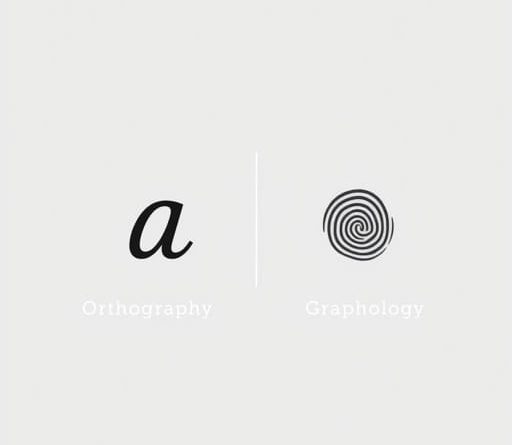
Difference Between Orthography And Graphology
The words ‘orthography’ and ‘graphology’ may sound similar, but they refer to completely different fields of study. Many people confuse them due to their linguistic roots and focus on writing or symbols. However, their meanings, applications, and relevance differ significantly. Understanding the difference between orthography and graphology is essential, especially in academic, linguistic, and psychological contexts. Each term holds its own significance and is used in very distinct areas of knowledge.
Definition and Meaning
What is Orthography?
Orthography refers to the conventional spelling system of a language. It includes the rules for writing words correctly, such as spelling, hyphenation, capitalization, word breaks, and punctuation. Orthography is not about handwriting or individual style it focuses on how words should appear when written in standardized form.
For example, English orthography dictates that the word ‘receive’ is spelled with ‘ei’ even though many might spell it ‘recieve’ due to pronunciation. This standardized approach is critical in education, publishing, and communication to maintain consistency in language.
What is Graphology?
Graphology, on the other hand, is the study of handwriting with the belief that it reveals personality traits. It is often considered a pseudoscience because its interpretations are subjective and not grounded in scientific evidence. Graphologists analyze the size, slant, pressure, and spacing of handwriting to make inferences about a person’s character, behavior, or psychological state.
For instance, someone who writes with heavy pressure might be seen as intense or emotional, while light handwriting could suggest a more introverted or sensitive personality. Although widely used in some recruitment processes or psychological assessments, graphology remains controversial in terms of its reliability.
Field of Application
Orthography in Linguistics and Education
Orthography plays a key role in linguistics, literacy, and education. It provides the framework through which students learn to read and write correctly. Language teachers, editors, translators, and publishers rely heavily on a clear understanding of orthographic rules.
It is also essential in language planning and reform. For instance, some countries have modernized their writing systems for simplicity and accessibility, such as the Turkish script reform in the 20th century. These changes are orthographic, not stylistic.
Graphology in Psychology and Hiring
Graphology is used by some psychologists and HR professionals who believe that handwriting can reveal cognitive or emotional states. Though it lacks wide scientific acceptance, some companies still use it as a supplementary tool in personality assessment.
Graphologists may also be consulted in forensic investigations to analyze anonymous notes or signatures. While not conclusive, it can sometimes provide supplementary insights when combined with other psychological or criminal profiling tools.
Scientific Basis and Credibility
Orthography: Backed by Linguistic Science
Orthography is a recognized linguistic discipline. It has firm rules and is supported by grammar, phonetics, morphology, and syntax. The development of orthographies is often done by language experts or academies dedicated to preserving and standardizing languages.
Changes to orthographic systems are typically well-documented and systematically implemented, making them dependable tools for education and communication.
Graphology: Criticized and Debated
In contrast, graphology is frequently criticized for its lack of empirical support. Many psychologists and scientists label it as a pseudoscience because its methods and conclusions are not consistently verifiable or replicable.
While some graphologists claim accuracy in personality assessments, there is insufficient peer-reviewed evidence to support the widespread application of graphology in serious scientific or psychological contexts.
Real-World Examples
- Orthography Example: Learning the correct spelling of English words like ‘necessary,’ ‘accommodate,’ or ‘definitely’ is part of mastering English orthography.
- Graphology Example: A graphologist might look at someone’s cursive handwriting and conclude that a narrow loop in the letter ‘l’ signifies restraint or caution in relationships.
Importance in Communication
Clarity and Standardization Through Orthography
Without standardized orthography, written communication would be chaotic. Readers would have difficulty interpreting text if every writer spelled words differently. Orthography ensures mutual understanding across all forms of written communication, whether formal or informal.
For digital tools such as spell-checkers and grammar-correction apps, orthographic rules are essential. These tools rely on standardized spelling and grammar to assist users in producing readable and professional content.
Graphology and Human Interpretation
Graphology, while not scientific, appeals to our natural tendency to seek patterns and meanings in behavior. Some view handwriting as a projection of the subconscious, making graphology an attractive if unreliable tool for exploring human personality.
Its use persists in certain fields where intuition and personality judgments are common, though many organizations now prefer psychometrically validated assessments.
Summary of Key Differences
- Definition: Orthography is about standardized spelling; graphology is the study of handwriting traits.
- Field: Orthography belongs to linguistics and language studies; graphology is associated with psychology and handwriting analysis.
- Scientific Basis: Orthography is well-established and evidence-based; graphology lacks scientific consensus.
- Application: Orthography is used in education, publishing, and technology; graphology is sometimes used in HR or forensic work.
- Purpose: Orthography ensures clarity in written language; graphology aims to infer personality or state of mind.
Understanding the difference between orthography and graphology helps clarify their unique roles in language and behavior analysis. While orthography is foundational to literacy and communication, graphology remains a more speculative and debated area. Being able to distinguish between the two not only enhances linguistic accuracy but also promotes informed discussions in education, psychology, and beyond. Whether analyzing spelling or exploring personality through handwriting, knowing the purpose and limitations of each term is key to using them appropriately in any context.