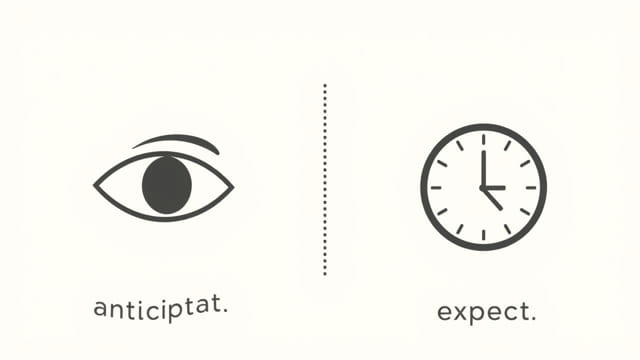
Difference Between Anticipate And Expect
Language is filled with subtle differences that can change the tone and meaning of what we say. Among these nuanced pairs, anticipate and expect often appear interchangeable at first glance, yet they carry distinctions in usage and connotation that affect both casual conversation and formal writing. Understanding the difference between anticipate and expect is essential for mastering precise communication. These two verbs may seem similar, but they convey different attitudes, emotional contexts, and implications about time and preparation.
Definition and Basic Usage
What Does Expect Mean?
Expect is a verb used to describe a belief or assumption that something will happen in the future. It conveys a sense of prediction or belief based on logical reasoning, past experience, or knowledge. The focus is generally on what is believed will occur without necessarily implying action in preparation for it.
- Example: I expect it to rain later today.
- Example: She expects him to arrive on time.
In these sentences, there is a passive sense of awaiting an event. There is no implication of acting in advance, only a belief or forecast of what will likely happen.
What Does Anticipate Mean?
Anticipate also refers to looking ahead to something, but with a different nuance. It usually implies not just prediction, but also action taken in response to that prediction. There is an element of preparation or even preemption embedded in the verb. Sometimes, anticipate also carries an emotional tone such as excitement or anxiety depending on context.
- Example: The event organizers anticipated bad weather and arranged for tents.
- Example: She anticipated the promotion with great excitement.
In these examples, anticipate involves more than just predicting; it includes preparing for or reacting to what is expected, either emotionally or practically.
Key Differences in Connotation
Level of Engagement
One of the main differences between expect and anticipate lies in the level of engagement implied. Expect often indicates a neutral or passive mindset. It’s a mental state of belief about what will happen. In contrast, anticipate suggests a more active role whether it’s preparing for something, trying to prevent it, or eagerly awaiting it.
Emotional Tone
Anticipate may carry emotional undertones that expect usually lacks. For example, anticipate can imply excitement, dread, or nervous energy. Saying you anticipate a concert implies eagerness and emotional investment. Saying you expect a concert sounds more mechanical or factual.
- We anticipate a great turnout. Suggests hopeful preparation and enthusiasm.
- We expect a great turnout. Indicates belief based on available data or experience.
Grammatical Contexts
Object and Infinitive Usage
Expect is often followed by an infinitive (to + verb) or by a clause. For instance:
- They expect himto arriveearly.
- I expectthat it will snowtomorrow.
Anticipate, on the other hand, is typically followed by a gerund (verb + -ing) or a noun:
- They anticipatedarrivinglate.
- She anticipatedthe problemsand found solutions in advance.
Understanding this distinction can help in constructing grammatically correct and natural-sounding sentences.
Examples in Different Contexts
Business Communication
In business, choosing the right word between anticipate and expect can affect how professional your message sounds. For instance:
- We expect to meet our quarterly goals. A factual projection based on current performance.
- We anticipate increased customer demand during the holidays. Implies not just a forecast but preparation for it.
Using anticipate in formal reports can signal proactive strategy, while expect emphasizes projections.
Everyday Conversation
In casual conversations, both words appear frequently, but emotional nuance often guides the choice:
- I expect my package to arrive tomorrow. A neutral statement of timing.
- I anticipate opening my gift! Suggests eagerness and excitement.
Common Mistakes and Misinterpretations
Assuming Complete Synonymy
One frequent mistake is treating anticipate and expect as full synonyms. While many dictionaries do mention overlapping definitions, in practical usage they are not always interchangeable. Misusing one in place of the other can subtly shift the meaning of a sentence or make it sound unnatural.
Using Incorrect Verb Forms
Another common error involves the verb form that follows the two words. Mixing infinitives and gerunds incorrectly can lead to awkward phrasing or grammatical mistakes:
- Incorrect: I anticipate to get a reply soon.
- Correct: I anticipate getting a reply soon.
Choosing the Right Word
Guidelines for Usage
When deciding between anticipate and expect, consider these points:
- Use expect when expressing a simple belief about the future.
- Use anticipate when referring to preparation or emotional investment.
- Use expect with infinitives or clauses.
- Use anticipate with gerunds or nouns.
By applying these guidelines, your language will sound more accurate, nuanced, and professional.
Examples in Literature and Media
Writers often choose one over the other to convey tone. In fiction, anticipate adds emotional depth, while expect supports a logical narrative. In journalism and academic writing, expect is more prevalent due to its objective tone, but anticipate can be found in opinion columns and feature stories to express sentiment or forward-looking actions.
Although anticipate and expect share some similarities, they are far from identical. Each carries its own set of implications emotional, grammatical, and contextual. Understanding the difference between anticipate and expect allows speakers and writers to convey messages more clearly and effectively. In situations requiring nuance, your word choice can subtly alter how your message is received. Being precise not only improves communication but also helps you sound more thoughtful, aware, and articulate. Mastering the difference is a small step with a big impact on fluency in English.