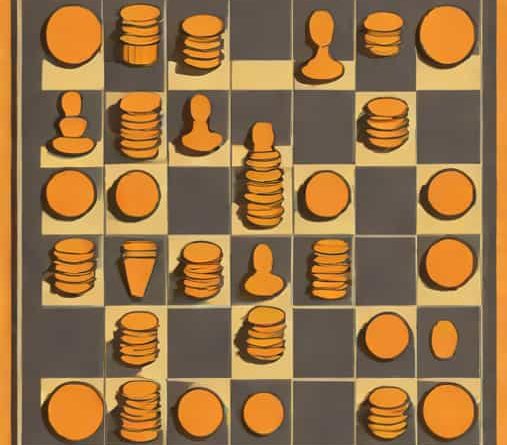
How Many Pennies Are On The Chessboard
The question of how many pennies are on the chessboard has fascinated students, mathematicians, and curious minds for generations. At first glance, it seems like a simple puzzle involving a familiar game board and ordinary coins. However, once you begin to explore the logic behind the problem, it quickly becomes a powerful illustration of exponential growth, mathematical reasoning, and how human intuition can be misled by large numbers. This classic thought experiment is often used in classrooms and discussions to show how quickly values can grow when they double repeatedly.
The Classic Chessboard and Pennies Puzzle
The puzzle usually begins with a standard chessboard, which has 64 squares arranged in an 8 by 8 grid. The rules are simple place one penny on the first square, two pennies on the second square, four pennies on the third square, and continue doubling the number of pennies on each subsequent square until all 64 squares are filled.
The question then becomes how many pennies are on the chessboard in total?
Why This Puzzle Seems Simple at First
At the beginning, the numbers appear very manageable. One penny, then two, then four, then eight. Even after ten squares, the total number of pennies still feels small. This early simplicity often leads people to underestimate the final result.
Human intuition is well suited for linear growth, but exponential growth behaves very differently. The chessboard pennies problem highlights this gap between intuition and mathematical reality.
Understanding Exponential Growth
Exponential growth occurs when a quantity doubles repeatedly over time or steps. In this puzzle, each square represents one step, and the number of pennies doubles from the previous square.
This type of growth is common in many real-world scenarios, such as population growth, compound interest, and the spread of information.
Key characteristics of exponential growth
- The value increases slowly at first
- Growth accelerates rapidly over time
- Final values can be surprisingly large
The Mathematical Formula Behind the Puzzle
To calculate how many pennies are on the chessboard, we use the formula for the sum of a geometric series. Each square represents a power of two, starting with 2⁰ on the first square.
The total number of pennies is the sum of
2⁰ + 2¹ + 2² +… + 2⁶³
This series has a well-known solution.
The Final Answer Explained
When all 64 squares are filled according to the doubling rule, the total number of pennies on the chessboard is
2⁶⁴ − 1 pennies
This equals 18,446,744,073,709,551,615 pennies.
This number is so large that it is difficult to imagine in practical terms.
How Much Money Is That in Dollars?
Since there are 100 pennies in one dollar, converting this amount into dollars makes the scale even clearer.
The total value would be
184,467,440,737,095,516 dollars
This amount far exceeds the total wealth that exists in the world today.
Putting the Number Into Perspective
Large numbers are hard to visualize, so it helps to compare the total number of pennies to real-world references.
Perspective comparisons
- Far more money than all global economies combined
- Enough pennies to cover vast areas of land if stacked
- More than any government or institution could realistically possess
The Origins of the Chessboard Story
This puzzle is often linked to an old legend involving the invention of chess. In the story, a wise inventor asks a king for a reward of grains of rice placed on a chessboard in the same doubling pattern.
The king initially agrees, thinking the request is modest, only to realize later that the amount is impossibly large.
Why Pennies Are Used in Modern Versions
While the original legend used rice, modern versions often replace grains with pennies to make the example more relatable. Pennies are familiar, tangible, and easy to count, which helps people engage with the puzzle.
Despite this familiarity, the final result remains just as shocking.
Educational Value of the Puzzle
The chessboard pennies problem is widely used in education because it demonstrates key mathematical concepts in a memorable way.
What learners gain from this puzzle
- Understanding exponential growth
- Improved number sense
- Awareness of how intuition can be misleading
- Appreciation for mathematical modeling
Why Most People Guess Wrong
When asked how many pennies are on the chessboard, most people drastically underestimate the total. This happens because the early stages of doubling do not feel dramatic.
By the time the numbers become enormous, the doubling effect has already gone far beyond intuitive reasoning.
The Last Few Squares Hold Most of the Pennies
An interesting detail of the puzzle is that the majority of the pennies are located on the final few squares.
In fact, more than half of the total pennies appear on the last square alone. This highlights how exponential growth concentrates value toward the end.
Applications Beyond the Puzzle
The lesson behind how many pennies are on the chessboard extends far beyond a simple math question. It applies to finance, technology, biology, and environmental studies.
Understanding exponential patterns helps people make better decisions in areas such as saving money, managing resources, and planning for long-term growth.
Common Variations of the Puzzle
Some versions of the puzzle change the starting number or use different objects instead of pennies. Others ask how long it would take to count all the pennies or transport them.
Each variation reinforces the same core lesson about exponential growth.
Why This Puzzle Remains Popular
The chessboard pennies puzzle remains popular because it is simple to explain, surprising in its result, and deeply educational.
It sparks curiosity and invites people to rethink their assumptions about numbers and growth.
The answer to how many pennies are on the chessboard is far more than just a large number. It represents a powerful idea about how exponential growth works and why humans often underestimate it. By starting with something as small as a single penny and doubling across 64 squares, the puzzle reveals how quickly values can grow beyond imagination. Whether used as a math lesson, a thought experiment, or a conversation starter, this classic problem continues to leave a lasting impression on anyone who explores it.