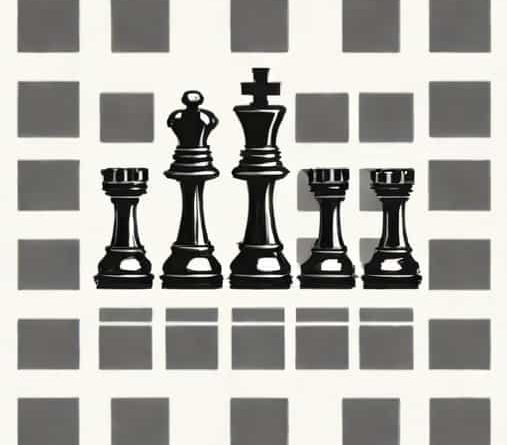
How Many White Squares On A Chessboard
The chessboard is one of the most recognizable elements in the world of board games, strategy, and intellectual competition. Consisting of a grid of alternating colored squares, it serves as the battlefield where chess pieces move, capture, and execute strategic plays. A common question that arises among beginners and enthusiasts alike is how many white squares are on a chessboard? Understanding the layout of a chessboard, including the distribution of white and black squares, is fundamental for both playing the game and appreciating its design. This question opens a window into the mathematics, symmetry, and visual patterns inherent in chess.
The Structure of a Chessboard
A standard chessboard consists of 64 squares arranged in an 8 by 8 grid. These squares alternate between two colors, traditionally black and white, creating a checkered pattern. Each row is called a rank, numbered 1 through 8, and each column is called a file, labeled a through h. The alternating pattern ensures that no two squares of the same color are adjacent vertically or horizontally. This design is essential for visual clarity and strategic movement, as many chess rules and tactics rely on recognizing square colors and their positions on the board.
Distribution of White and Black Squares
Because a chessboard has 64 squares in total and the colors alternate evenly, exactly half of the squares are white, and the other half are black. Mathematically, this can be expressed as
- Total squares 8 Ã 8 = 64
- Number of white squares 64 ÷ 2 = 32
- Number of black squares 64 ÷ 2 = 32
This symmetry is critical for gameplay because certain pieces, such as bishops, are restricted to moving only on squares of one color throughout the game. Therefore, one bishop starts on a white square and the other on a black square. Understanding the total number of white squares helps players appreciate this balance and plan their strategies accordingly.
Positioning of White Squares
On a chessboard, white squares occupy every other position, both horizontally and vertically. The bottom-right corner square is always white, which is an essential rule when setting up a chessboard for play. From this starting point, the white and black squares alternate across ranks and files. For example, in the first rank, the sequence begins with a white square, followed by black, white, black, and so on. The pattern continues in alternating rows, ensuring that the visual checkerboard effect is maintained.
Importance in Gameplay
The color of squares has practical implications for chess strategy. Many opening principles, middle-game tactics, and endgame strategies involve controlling squares of specific colors. For instance
- BishopsEach bishop is limited to the color of square it starts on. One controls the white squares, while the other controls the black squares.
- Queen and King SafetyCertain defensive structures rely on controlling white squares to prevent attacks.
- Pawn StructuresPawns create strongholds on squares of alternating colors, influencing mobility and control.
Understanding the total number and placement of white squares allows players to visualize potential moves, anticipate threats, and maintain strategic balance across the board.
Mathematical Perspective
From a mathematical perspective, the 8 Ã 8 chessboard represents an example of even distribution and symmetry. Each rank and file contains an equal number of white and black squares, precisely 4 each. This can be generalized as follows
- Each rank 8 squares â 4 white + 4 black
- Each file 8 squares â 4 white + 4 black
- Total board 8 ranks à 4 white squares per rank = 32 white squares
This uniform distribution contributes to fairness and predictability in chess, as both players have equal opportunities to control squares of each color. It also facilitates mathematical exercises, such as calculating the number of possible positions for certain pieces or exploring combinatorial problems in chess puzzles.
Chess Puzzles and Square Colors
Many chess puzzles and endgame studies rely on the distinction between white and black squares. For instance, the bishop and pawn vs. king scenario depends on the bishop controlling squares of a specific color. Understanding that there are 32 white squares allows players to anticipate which squares their pieces can reach and which remain inaccessible. Similarly, strategic concepts like color complexes involve groups of squares of the same color that must be defended or attacked. Recognizing the total number of white squares provides a framework for analyzing these patterns effectively.
Practical Applications Beyond Gameplay
The concept of white squares on a chessboard extends beyond pure gameplay. Chessboards are often used in mathematical demonstrations, programming exercises, and even art projects to illustrate symmetry and patterns. For example, computer algorithms that simulate chess games or solve puzzles rely on accurate knowledge of square colors and their total numbers. Additionally, educational activities may use the chessboard’s white and black squares to teach fractions, division, and spatial reasoning. Knowing that there are 32 white squares is fundamental in these applications.
Visualization and Strategy Training
Chess players often visualize the board in their minds to plan ahead, especially when calculating moves several turns in advance. Memorizing that half the squares are white, and their specific arrangement, helps in predicting the paths of pieces like bishops and queens. Training exercises frequently include scenarios that involve controlling or occupying key white squares to maximize influence and restrict the opponent’s options. This mental mapping strengthens both strategic thinking and memory skills, demonstrating the broader cognitive benefits of chess.
Historical and Cultural Significance
The 8 Ã 8 chessboard with 32 white squares has historical roots that date back centuries. The alternating colored squares were designed to improve visibility and distinguish between legal moves, particularly in early chess manuscripts and physical boards. Culturally, the black-and-white pattern has become symbolic of strategic thinking, duality, and balance. Artists, mathematicians, and educators have drawn inspiration from this simple yet profound layout, reinforcing its significance beyond competitive play.
Symbolism of White Squares
White squares are often associated with clarity, light, and positive energy in various cultural interpretations of chess. In contrast, black squares represent mystery, challenge, and strategic obstacles. The balance between these two colors, each comprising exactly half of the board’s squares, symbolizes equilibrium and fairness in competition. For chess enthusiasts, understanding the 32 white squares is not just a numerical fact but also an appreciation of the game’s aesthetic and philosophical dimensions.
a standard chessboard contains 32 white squares, precisely half of its total 64 squares. This arrangement is crucial for both practical gameplay and strategic planning, influencing how pieces move and interact. The alternating pattern of white and black squares ensures balance, symmetry, and clarity, serving as the foundation for countless strategies and puzzles. Beyond the game itself, the white squares contribute to mathematical explorations, cognitive training, and cultural symbolism. Understanding the number and placement of white squares on a chessboard allows players and enthusiasts to appreciate both the beauty and the complexity of one of the world’s most enduring and intellectually stimulating games.