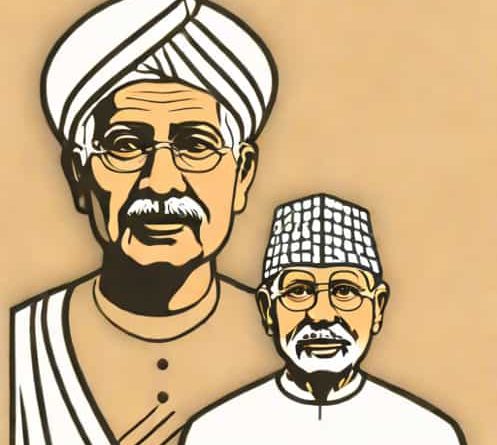
Gandhi Nehru Aur Yasser Arafat
Throughout the twentieth century, three prominent figures-Mahatma Gandhi, Jawaharlal Nehru, and Yasser Arafat-emerged as defining leaders in their respective regions. Gandhi and Nehru were central to India’s struggle for independence, while Arafat became the face of the Palestinian liberation movement. Though they came from different backgrounds, their lives were connected by common ideals the pursuit of freedom, self-determination, and justice for their people. Understanding Gandhi, Nehru, and Arafat provides deep insight into the political and moral transformations that shaped Asia and the Middle East in the modern era.
The Vision of Mahatma Gandhi
Mahatma Gandhi, born in 1869, is best known as the leader of India’s nonviolent independence movement against British colonial rule. His philosophy ofahimsa(nonviolence) andsatyagraha(truth-force) became powerful tools for political change. Gandhi’s method was not merely a strategy; it was a way of life rooted in morality, spirituality, and human dignity.
Gandhi believed that true freedom came not only from political independence but also from moral awakening. His campaigns, such as the Salt March and the Quit India Movement, inspired millions to join the struggle without resorting to violence. His simplicity and deep empathy for the poor reflected his vision of an egalitarian India.
One of Gandhi’s lasting influences was his impact on global civil rights movements. Leaders like Martin Luther King Jr. and Nelson Mandela drew inspiration from his approach to peaceful resistance. Gandhi showed that moral courage could overcome military power, an idea that continues to resonate across the world.
Gandhi’s Relationship with Nehru
Among Gandhi’s closest associates was Jawaharlal Nehru, who later became India’s first Prime Minister. Though they shared the goal of an independent India, they often differed in ideology. Gandhi’s focus was spiritual and rural, advocating for self-reliant villages and minimal industrialization. Nehru, in contrast, was a modernist who believed that science and technology were essential for India’s progress.
Despite these differences, their relationship was built on mutual respect. Gandhi saw Nehru as a natural leader of the new India, someone who could bridge traditional values and modern governance. When India finally gained independence in 1947, Nehru’s leadership reflected many of Gandhi’s principles, particularly the emphasis on tolerance and secularism.
Jawaharlal Nehru Architect of Modern India
Jawaharlal Nehru, born in 1889, was a man of intellect, vision, and passion. Educated at Harrow and Cambridge, he was influenced by Western liberalism but deeply committed to India’s cultural identity. Nehru envisioned an India that was democratic, socialist in outlook, and secular in nature-a country that balanced progress with equality.
As India’s first Prime Minister, Nehru laid the foundation of a modern nation. His policies emphasized industrialization, scientific research, and education. He established institutions like the Indian Institutes of Technology (IITs) and Indian Institutes of Management (IIMs), which became global centers of excellence. Nehru’s foreign policy of non-alignment, especially during the Cold War, reflected his belief that newly independent nations should not be subservient to any global power bloc.
Nehru’s Ideological Legacy
Nehru’s vision of India continues to shape the nation’s identity. His emphasis on secularism promoted religious harmony in a diverse country, while his democratic ideals ensured freedom of thought and expression. Although critics argue that his economic policies were too state-controlled, his focus on equality and inclusivity remains a cornerstone of India’s development path.
Nehru’s deep respect for Gandhi influenced his leadership style. He often referred to Gandhi as Bapu, meaning father, and continued to uphold many of his principles even as he guided India into a new industrial age. Nehru’s eloquent speeches and writings, such as his bookThe Discovery of India, reflect his philosophical depth and his dream of a united, forward-looking nation.
Yasser Arafat The Symbol of Palestinian Resistance
Yasser Arafat, born in 1929, was a revolutionary leader who dedicated his life to the Palestinian cause. As the head of the Palestine Liberation Organization (PLO), Arafat became a symbol of national identity and resilience. While Gandhi and Nehru sought to liberate India from British colonialism, Arafat fought for the recognition of Palestine as an independent state.
Unlike Gandhi’s approach of nonviolence, Arafat’s struggle was marked by both political negotiation and armed resistance. His leadership evolved over time-from militant beginnings to diplomatic efforts aimed at achieving peace through dialogue. The 1993 Oslo Accords, where Arafat signed an agreement with Israeli Prime Minister Yitzhak Rabin, earned him the Nobel Peace Prize alongside Rabin and Shimon Peres.
The Global Impact of Arafat’s Leadership
Yasser Arafat’s leadership made the Palestinian issue a central topic in international politics. His persistence ensured that the Palestinian struggle for self-determination remained visible on the world stage. Though his methods were controversial, his commitment to his people was unwavering.
Arafat’s political philosophy shared some similarities with Gandhi and Nehru. Like them, he believed that a nation’s identity was tied to its cultural and historical roots. His dream of a free Palestine was deeply connected to the collective memory and pride of his people. Despite decades of conflict and negotiation, Arafat’s legacy continues to inspire movements for freedom and justice worldwide.
Shared Ideals and Global Influence
Though Gandhi, Nehru, and Arafat belonged to different eras and regions, their struggles shared common themes-freedom, justice, and national dignity. Each of them confronted powerful forces of oppression and sought to uplift their people through vision and perseverance.
- Gandhibelieved in transforming society through moral and spiritual strength.
- Nehruworked to build a democratic and modern nation based on rational governance.
- Arafatrepresented the political resilience of a people fighting for recognition and sovereignty.
All three leaders faced criticism and challenges, but they also inspired hope across continents. Their legacies extend beyond their nations-they represent humanity’s continuous struggle for self-determination and peace.
Lessons from Their Lives
The lives of Gandhi, Nehru, and Arafat teach us that leadership is not only about power but about responsibility. They demonstrated that conviction and compassion can coexist, even in the most turbulent times. Their stories remind us that every movement for liberation must be rooted in empathy and respect for human life.
In a world still divided by conflict, inequality, and injustice, the messages of Gandhi, Nehru, and Arafat remain profoundly relevant. They challenge us to act with conscience, to value dialogue over violence, and to seek progress that benefits all humanity.
The legacies of Gandhi, Nehru, and Yasser Arafat reveal the enduring power of vision and determination. Gandhi’s moral leadership, Nehru’s nation-building, and Arafat’s unwavering pursuit of identity each symbolize a different aspect of human resilience. Together, they illustrate how one person’s faith in freedom can transform the destiny of millions. Whether through peace, politics, or perseverance, their stories continue to inspire generations striving for a more just and harmonious world.