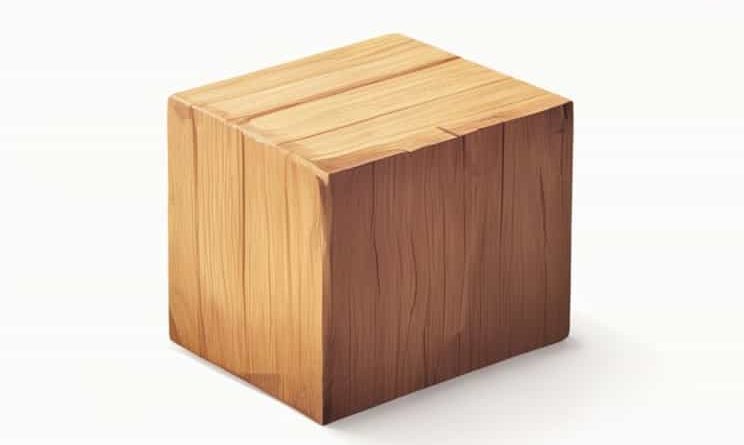
A Cubical Block Of Wood Weighing 200g
Understanding a simple object, such as a cubical block of wood weighing 200 grams, can reveal a wealth of knowledge about physics, materials science, and practical applications in everyday life. At first glance, a small wooden cube might seem mundane, but examining its properties, density, dimensions, and uses demonstrates how even seemingly simple items play a significant role in learning and experimentation. By exploring this example, one can gain insight into measurement techniques, weight distribution, and the physical characteristics that define materials and their applications.
Properties of the Cubical Block
A cubical block of wood has distinct physical properties that make it easy to analyze and utilize for various purposes. Its geometric shape a cube implies equal dimensions on all sides, which simplifies calculations related to volume, surface area, and density. The weight of 200 grams provides a practical measure for understanding mass and its relation to volume in materials science studies.
Volume and Dimensions
The volume of a cube is calculated by raising the length of one side to the third power. If the mass of the cube is 200 grams and the density of the wood is known, one can easily determine the length of each side. This demonstrates how physics and mathematics intersect in real-world applications. Additionally, knowing the dimensions helps in practical uses, such as construction, crafting, or educational experiments.
Density Considerations
Density is defined as mass per unit volume and is a crucial property for understanding materials. For a wooden block weighing 200 grams, density can provide insight into the type of wood, its buoyancy in water, and its suitability for specific applications. Different woods have different densities, affecting their strength, durability, and performance in construction or craft projects. Measuring the density of a cube also helps students and researchers develop precision in scientific observation.
Applications in Learning and Education
A cubical block of wood weighing 200 grams can be an excellent educational tool. Its simplicity and measurable properties make it suitable for teaching fundamental concepts in physics, such as gravity, force, and motion. It can also demonstrate the principles of volume, surface area, and material density. Using tangible objects in teaching enhances comprehension and retention of abstract scientific concepts.
Experiments in Physics
In physics classes, a wooden cube can be used to demonstrate basic principles like Newton’s laws of motion. By applying different forces to the cube, students can observe acceleration, friction, and inertia. Its uniform shape ensures consistent results in experiments, making it an ideal learning tool. Additionally, comparing cubes of different densities or weights helps illustrate material properties and their effects on motion and stability.
Mathematical Applications
The cube also serves as an example for mathematical calculations. Students can calculate surface area, volume, and density using the weight and dimensions of the cube. These exercises reinforce the connection between mathematics and real-world objects, making abstract formulas more tangible and comprehensible. The 200-gram weight provides a realistic scenario for measurement exercises in educational settings.
Practical Uses
Beyond education, a cubical block of wood weighing 200 grams has practical applications in design, construction, and hobbies. Its manageable size and weight make it versatile for crafting, woodworking, and even as a calibration tool for measuring balances and scales. The uniform shape allows for stacking, modeling, and experimentation, making it a useful component in both professional and recreational contexts.
Crafting and Woodworking
In crafting and woodworking, small wooden cubes are often used to create decorative items, puzzles, or functional objects. The weight of 200 grams ensures stability while remaining easy to manipulate. Understanding the properties of the wood, including its density and strength, allows craftsmen to select the right material for their projects. Cubes can be painted, carved, or joined to create more complex structures.
Engineering and Design Models
Engineers and designers use wooden blocks to model larger structures or to prototype mechanical systems. A uniform cube provides predictable behavior, allowing for accurate testing and planning. The weight of 200 grams is light enough to handle easily but substantial enough to demonstrate real-world physics effects. These models help professionals understand load distribution, stability, and design feasibility before applying concepts to larger constructions.
Scientific Experiments and Measurements
Wooden cubes are frequently used in scientific experiments to study material properties, buoyancy, and mass-to-volume relationships. A cube weighing 200 grams can be placed in water to examine floating behavior, or it can be used to measure friction on different surfaces. Scientists can also use the cube to calibrate instruments or conduct controlled experiments on pressure and force distribution.
Buoyancy and Density Experiments
The principle of buoyancy states that an object submerged in a fluid experiences an upward force equal to the weight of the fluid displaced. A 200-gram wooden cube can be used to explore this principle, helping students understand density relationships and floating behavior. By comparing cubes of different weights or types of wood, learners gain practical insight into material properties and physical laws.
Force and Friction Studies
By sliding the cube across various surfaces, students and researchers can study frictional forces. The weight of the cube influences the amount of friction encountered, providing measurable outcomes for experiments. Observing the cube’s behavior on different textures also teaches important lessons about material interactions and real-world applications in engineering and physics.
A cubical block of wood weighing 200 grams may appear simple, but it is rich with educational, practical, and scientific value. Its uniform shape, measurable mass, and predictable physical properties make it an ideal tool for learning about density, volume, surface area, and physics principles. Beyond education, such cubes are versatile in crafting, design, and experimental applications. By examining the properties and uses of a 200-gram wooden cube, we can appreciate how even the simplest objects provide insight into fundamental scientific concepts, practical skills, and creative problem-solving. This small yet significant object demonstrates that understanding materials and their properties can illuminate larger principles in physics, engineering, mathematics, and art, making it a perfect example of the intersection between theory and practice.