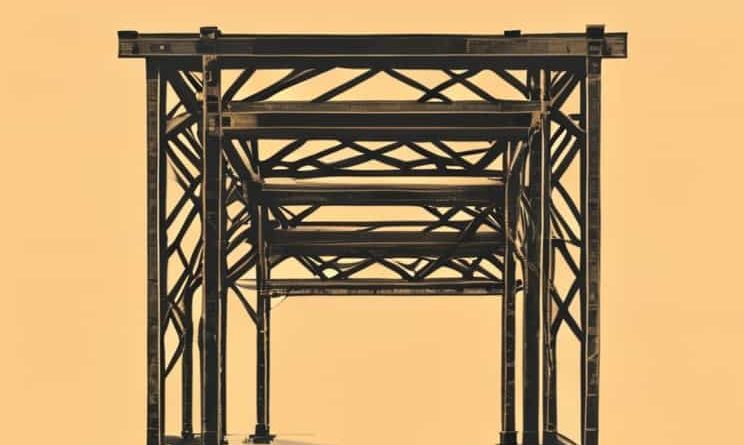
Analysis Of Statically Determinate Trusses
Structural engineering plays a crucial role in the design and construction of buildings, bridges, and various mechanical structures. Among the many structural systems, trusses are widely used due to their efficiency in supporting loads while minimizing material usage. A truss is a framework composed of members connected at joints, typically arranged in triangular units. Understanding the analysis of statically determinate trusses is fundamental for engineers, as it allows them to calculate forces in each member using principles of static equilibrium, ensuring safety and stability of the structure.
What is a Statically Determinate Truss?
A statically determinate truss is a truss in which all member forces can be determined solely using the equations of static equilibrium. These trusses satisfy the condition where the number of unknown member forces equals the number of available equilibrium equations. Statically determinate trusses are preferred in many engineering applications because their analysis is straightforward, and the results are reliable as long as the assumptions of idealized pin joints and negligible member deformation hold true.
Characteristics of Statically Determinate Trusses
- All forces in the truss members can be calculated using equilibrium equations alone.
- The structure is stable and does not deform under load unless the loads exceed design limits.
- Typically, trusses are constructed with pin connections at joints, allowing rotation but not translation.
- The truss satisfies the equationm + r = 2j, wheremis the number of members,ris the number of reactions, andjis the number of joints.
Principles of Analysis
Analysis of statically determinate trusses involves determining the forces in each member to ensure that the truss can safely carry the applied loads. The analysis is based on two fundamental principles of mechanics
Equilibrium of Joints
In this method, each joint in the truss is treated as a point where members converge. The sum of forces in the horizontal and vertical directions at each joint must equal zero. By systematically analyzing one joint at a time, the forces in the connected members can be calculated.
- ∑Fx = 0 Sum of horizontal forces must be zero.
- ∑Fy = 0 Sum of vertical forces must be zero.
This method is particularly effective for trusses with a limited number of members per joint, making it easier to solve equations step by step.
Method of Sections
The method of sections involves cutting through the truss to isolate a section and then applying equilibrium equations to that section. This approach allows direct calculation of forces in specific members without analyzing every joint individually. The steps typically include
- Identify the section that passes through the members of interest.
- Draw a free-body diagram of one part of the truss after the cut.
- Apply equilibrium equations (∑Fx = 0, ∑Fy = 0, ∑M = 0) to solve for unknown member forces.
This method is highly efficient for finding forces in members located in the interior of a large truss where the method of joints would be cumbersome.
Steps for Analyzing Statically Determinate Trusses
To perform a complete analysis of a statically determinate truss, engineers follow a series of systematic steps
- Identify and draw the truss structure, including all members and joints.
- Determine the support reactions using the overall equilibrium of the truss.
- Use the method of joints or method of sections to calculate the forces in individual members.
- Classify each member as either in tension or compression based on the direction of the force.
- Verify calculations by checking that all joints satisfy equilibrium equations.
Tension and Compression in Truss Members
Understanding whether a member is in tension or compression is crucial for selecting appropriate materials and cross-sectional dimensions. Members in tension are being pulled apart, while members in compression are being pushed together. Engineers use these classifications to determine the design requirements, such as material strength and buckling resistance, ensuring that the truss can withstand applied loads without failure.
Applications of Statically Determinate Trusses
Statically determinate trusses are widely used in various engineering projects due to their predictable behavior and ease of analysis. Common applications include
- Roof structures in residential and industrial buildings.
- Bridges, particularly small to medium-span truss bridges.
- Towers and transmission line supports.
- Mechanical frames and cranes.
These applications benefit from the lightweight and efficient nature of trusses, which can carry significant loads with minimal material usage.
Advantages of Statically Determinate Trusses
Statically determinate trusses offer several advantages for engineers and designers
- Predictable behavior under load, making safety assessments straightforward.
- Ease of calculation using only equilibrium equations.
- Less material usage compared to solid beams, reducing construction costs.
- Flexibility in design, allowing for a variety of shapes and sizes.
Limitations and Considerations
While statically determinate trusses are advantageous, they also have limitations
- They are sensitive to support settlements; even minor movements can induce additional forces.
- Assumptions of pin-jointed members and negligible deformations may not hold in real-world scenarios.
- Not suitable for very large or highly complex structures where indeterminacy is required for stability.
The analysis of statically determinate trusses is a foundational concept in structural engineering. By applying the principles of equilibrium, engineers can accurately determine the forces in each truss member and ensure that the structure is safe, efficient, and cost-effective. Methods such as the method of joints and method of sections provide reliable tools for calculating member forces, while proper classification into tension and compression guides material selection and design. Despite some limitations, statically determinate trusses remain a popular choice in construction and engineering projects worldwide, demonstrating the enduring importance of this analytical approach in modern structural design.