Asal Usul Candi Borobudur
Standing majestically in Central Java, Indonesia, Borobudur Temple is considered one of the greatest architectural achievements in Southeast Asia and the world. Its origins, however, remain a fascinating subject filled with history, culture, and spiritual significance. Built in the 8th and 9th centuries, Borobudur reflects the height of Javanese civilization during the Sailendra dynasty, blending Indian Buddhist influence with local artistic traditions. Exploring the origin of Borobudur Temple helps us understand not only the religious devotion of its creators but also the rich cultural heritage that continues to shape Indonesia today.
Historical Background of Borobudur
The construction of Borobudur Temple is generally attributed to the Sailendra dynasty, which ruled Java during the 8th and 9th centuries. This powerful dynasty was known for its devotion to Mahayana Buddhism and its role in promoting both religion and culture across the Indonesian archipelago. The temple is believed to have been built between 750 and 850 CE, a period that marked the golden age of Javanese temple construction.
The Sailendra Dynasty
The Sailendra rulers were influential in spreading Buddhism in Java and neighboring regions. Their close connections with the Gupta Empire in India brought artistic and religious inspiration, which played a significant role in shaping Borobudur’s design. The dynasty invested vast resources into creating monumental temples, with Borobudur being their most magnificent legacy.
Religious Context
Borobudur was constructed as a Buddhist monument that represented the universe in symbolic form. Its structure is not just architectural but also deeply spiritual, reflecting Buddhist cosmology and teachings. Pilgrims would circumambulate the temple, moving upward through its levels as a symbolic journey toward enlightenment.
Architectural Origins
The architectural design of Borobudur is unique in the world. While it shares influences with Indian stupas, it also incorporates local Javanese traditions and symbolism, making it a distinct masterpiece of cultural synthesis.
Symbolism in the Structure
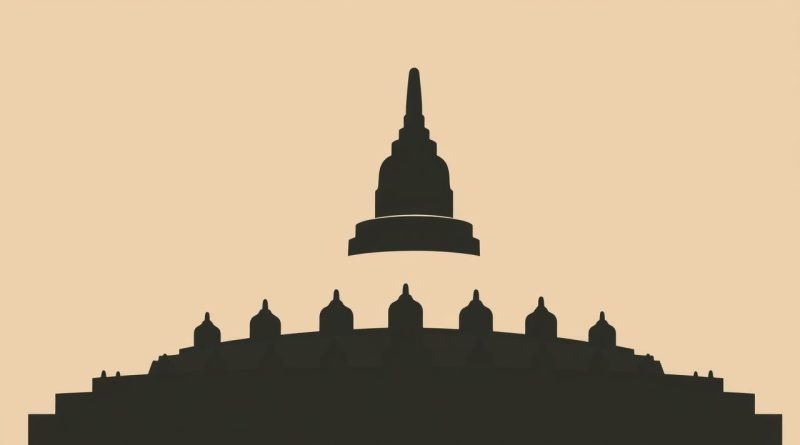
Borobudur was built in the form of a massive stupa, shaped like a mandala when viewed from above. Its design consists of three main levels, each representing stages of spiritual progress in Buddhism
- Kāmadhātu– the world of desire, represented by the base of the temple.
- Rūpadhātu– the world of forms, represented by the square terraces with relief panels.
- Arūpadhātu– the formless world, represented by the circular terraces with stupas and the main central dome.
This arrangement mirrors Buddhist cosmology and guides pilgrims on a spiritual path toward enlightenment.
Engineering Feats
The temple was built using volcanic stone from nearby rivers. Without the use of mortar, the stones were carefully interlocked, creating a stable structure that has withstood centuries of natural challenges. The design also included a complex drainage system to protect the monument from heavy tropical rainfall, showcasing advanced engineering knowledge of the time.
Cultural Influences on Borobudur
The origin of Borobudur cannot be separated from the cultural exchanges taking place in Southeast Asia during the 8th century. Java was a hub of trade and cultural interaction, receiving influences from India, China, and other parts of Asia.
Indian Influence
The temple’s Buddhist concepts, stupas, and mandala-like layout show clear connections with Indian architecture and religious traditions. However, the execution was uniquely Javanese, demonstrating how local builders adapted foreign ideas into their own cultural framework.
Javanese Traditions
Local beliefs and customs also shaped Borobudur’s construction. Indigenous Javanese respect for mountains and natural landscapes influenced the decision to build the temple on a hill surrounded by volcanoes. This setting emphasized harmony between nature, spirituality, and architecture.
The Relief Panels
One of the most remarkable aspects of Borobudur is its extensive relief carvings, which provide insights into the temple’s origin and purpose. Covering more than 2,600 panels, the reliefs depict a wide range of scenes, from Buddhist teachings to daily life in ancient Java.
Buddhist Stories
Many panels illustrate the life of Siddhartha Gautama, the historical Buddha, along with Jataka tales that teach moral lessons through stories of his previous lives. These carvings served as a teaching tool for pilgrims and worshippers.
Depictions of Ancient Java
Other panels portray ships, markets, and agricultural life, offering valuable historical records of the culture, economy, and technology of 8th-century Java. These scenes reveal how the temple was not only a spiritual center but also a reflection of its society.
The Rediscovery of Borobudur
After centuries of abandonment, Borobudur was rediscovered in the early 19th century during the colonial period. Natural disasters, volcanic eruptions, and the decline of Buddhism in Java contributed to its neglect. The rediscovery sparked international interest and efforts to restore the monument to its former glory.
Restoration Efforts
Major restoration projects, particularly in the 20th century under UNESCO guidance, helped preserve Borobudur for future generations. These efforts highlight the global recognition of its cultural and historical importance.
Spiritual and Cultural Legacy
Borobudur’s origin is deeply tied to both religion and identity. Today, it serves not only as a tourist destination but also as a sacred site for Buddhist rituals, including annual celebrations of Vesak. The temple embodies Indonesia’s rich cultural diversity and stands as a symbol of unity between past and present.
A World Heritage Site
In 1991, Borobudur was designated a UNESCO World Heritage Site, cementing its status as a global treasure. Its origins as a symbol of Buddhist devotion continue to inspire awe and respect worldwide.
The origin of Borobudur Temple is a story of devotion, cultural fusion, and architectural brilliance. Built by the Sailendra dynasty in the 8th century, it stands as a monument to Mahayana Buddhism and Javanese creativity. With its symbolic structure, intricate reliefs, and enduring spiritual significance, Borobudur remains a timeless masterpiece. Its roots connect history, religion, and culture, making it one of the most remarkable monuments not only in Indonesia but in the world.