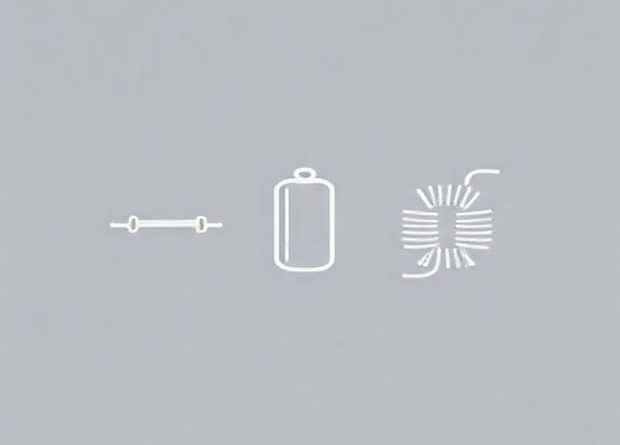
Difference Between Resistor, Capacitor, And Inductor
In the field of electronics, understanding the basic components is crucial for anyone working with circuits. Among the most fundamental components are resistors, capacitors, and inductors. Each of these elements has a unique function, behavior, and effect on electrical circuits. While they may all be passive components, they respond differently to voltage and current and are used in various applications ranging from simple circuits to complex electronic systems. Knowing the differences between resistors, capacitors, and inductors helps in designing efficient circuits and troubleshooting electrical problems effectively.
Resistors Controlling Current Flow
A resistor is an electrical component designed to limit or regulate the flow of electric current in a circuit. Its main function is to provide resistance, measured in ohms (Ω), which determines how much it resists the flow of electrons. Resistors do not store energy; instead, they dissipate it in the form of heat according to Ohm’s Law, which states that V = IR, where V is voltage, I is current, and R is resistance.
Key Characteristics of Resistors
- Provide a fixed or variable resistance to control current.
- Do not store energy; they dissipate it as heat.
- Used for voltage division, current limiting, and biasing circuits.
- Available in various types such as carbon film, metal film, and wire-wound resistors.
Applications of Resistors
Resistors are commonly used in electronic devices for controlling LED brightness, setting operating points in transistors, protecting sensitive components, and creating timing circuits in combination with capacitors. Their predictable behavior makes them essential in almost every electronic design.
Capacitors Storing and Releasing Energy
Unlike resistors, capacitors are components that store electrical energy temporarily in an electric field. They consist of two conductive plates separated by an insulating material called a dielectric. The ability of a capacitor to store charge is measured in farads (F). Capacitors resist changes in voltage by absorbing or releasing energy, which makes them essential for filtering, smoothing, and energy storage applications.
Key Characteristics of Capacitors
- Store energy in the form of an electric field.
- Block direct current (DC) while allowing alternating current (AC) to pass.
- Capacitance depends on plate area, distance between plates, and dielectric material.
- Available types include ceramic, electrolytic, tantalum, and film capacitors.
Applications of Capacitors
Capacitors are used in power supply circuits to smooth voltage fluctuations, in audio equipment to block DC signals, and in timing circuits when combined with resistors. They are also crucial in energy storage devices, coupling and decoupling circuits, and frequency tuning applications.
Inductors Reacting to Changes in Current
Inductors are passive components that store energy in a magnetic field when electrical current flows through a coil of wire. Their ability to resist changes in current is called inductance, measured in henries (H). Unlike resistors, inductors do not dissipate energy as heat under ideal conditions. Instead, they oppose sudden changes in current, making them important in filtering, energy storage, and inductive coupling applications.
Key Characteristics of Inductors
- Store energy in a magnetic field generated by current.
- Resist changes in current, especially in AC circuits.
- Inductance depends on the number of turns in the coil, core material, and coil geometry.
- Used in chokes, transformers, and tuning circuits.
Applications of Inductors
Inductors are widely used in power supplies to smooth out current variations, in radio frequency circuits for tuning and filtering, and in transformers for energy transfer between circuits. Their unique ability to store energy in a magnetic field allows them to work effectively in combination with capacitors to form resonant circuits and manage alternating currents.
Comparing Resistors, Capacitors, and Inductors
While resistors, capacitors, and inductors are all passive components, their behaviors in a circuit are distinctly different. Resistors provide constant opposition to current and dissipate energy as heat. Capacitors store energy in an electric field and resist changes in voltage, while inductors store energy in a magnetic field and resist changes in current. Understanding these differences is key for designing circuits with desired behaviors.
Summary of Differences
- ResistorProvides resistance, dissipates energy as heat, obeys Ohm’s Law.
- CapacitorStores energy in an electric field, blocks DC, allows AC, measured in farads.
- InductorStores energy in a magnetic field, opposes changes in current, measured in henries.
Practical Considerations in Circuit Design
Choosing between a resistor, capacitor, or inductor depends on the circuit requirements. If the goal is to limit current, a resistor is ideal. For energy storage or filtering voltage variations, capacitors are preferable. Inductors are best for controlling current changes or forming resonant circuits. Often, these components are used together to achieve complex functions, such as in RLC circuits where the interplay between resistance, capacitance, and inductance controls frequency response and damping.
Example Circuit Applications
- Resistor-capacitor (RC) circuits for timing and filtering applications.
- Inductor-capacitor (LC) circuits for radio frequency tuning and signal processing.
- Resistor-inductor-capacitor (RLC) circuits in oscillators and waveform shaping.
- Power supply circuits using resistors for current limiting, capacitors for smoothing, and inductors for filtering.
Resistors, capacitors, and inductors form the foundation of modern electronics. Each component has distinct characteristics that determine its role in a circuit. Resistors limit current and dissipate energy, capacitors store energy and smooth voltage variations, and inductors store energy in magnetic fields and oppose changes in current. A solid understanding of their differences and behaviors allows engineers and hobbyists to design efficient, reliable, and effective electronic systems. By leveraging these fundamental components wisely, complex circuits can be constructed, ranging from basic household electronics to sophisticated industrial and communication devices.