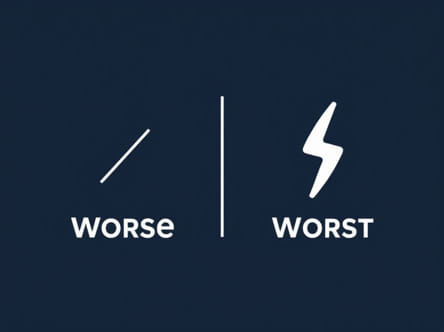
Difference Between Worse And Worst
Many English learners often find themselves confused between the words ‘worse’ and ‘worst.’ Even native speakers occasionally hesitate when choosing which one to use. Although both words are comparative forms of bad, they have very different uses. Understanding the difference between worse and worst is important for anyone aiming to speak and write English correctly and clearly. This topic explains these differences in depth, with plenty of examples and explanations to make the usage clear and memorable.
Understanding the Basics: Worse vs. Worst
Both ‘worse’ and ‘worst’ are forms of the adjective bad. However, they serve different grammatical purposes and appear in different sentence structures.
- Worseis the comparative form of ‘bad.’
- Worstis the superlative form of ‘bad.’
Definition of Worse
Worse is used to compare two things. It tells us that one thing is more negative or of lower quality than another. It comes from the adjective bad and is used when we are dealing with comparisons between only two items, people, situations, or conditions.
Examples of Worse in Sentences
- This movie is worse than the one we watched last night.
- Her health has gotten worse since last week.
- The traffic today is worse than it was yesterday.
In all these examples, worse is used to compare one situation to another. It highlights a decline or a negative shift between the two.
Definition of Worst
Worst is used when we are comparing more than two things and identifying the most negative or most severe one. It signifies the lowest or most unfavorable point among a group.
Examples of Worst in Sentences
- This is the worst meal I’ve ever had.
- That was the worst performance of the entire show.
- He is the worst player on the team.
In these cases, worst is used to express that something is not just bad, but the most bad when compared to several others.
Grammatical Role and Structure
How Worse Functions
Worse is usually used with the word than to make comparisons. It can function as both an adjective and an adverb.
- As an adjective: The situation is worse than expected.
- As an adverb: She sings worse than her sister.
How Worst Functions
Worst is typically used with the word the because it identifies a specific item in a group as having the most negative quality. It also functions as an adjective or an adverb.
- As an adjective: That was the worst decision we could have made.
- As an adverb: Of all the students, he performed the worst.
Common Mistakes and How to Avoid Them
Using Worse When You Mean Worst
Sometimes people say worse when they are talking about the most negative among a group of three or more. This is incorrect. If you are not comparing just two things, always use worst.
Incorrect: This is worse movie of all time.
Correct: This is the worst movie of all time.
Using Worst When You Mean Worse
Using worst when comparing only two things is also a common mistake.
Incorrect: My grade is worst than yours.
Correct: My grade is worse than yours.
Tips to Remember the Difference
- Useworsewhen comparing two things.
- Useworstwhen identifying the most negative among three or more.
- Look for the word than it usually signals a comparison between two, and that’s your clue to use worse.
- Look for the before the word if it’s there and the sentence implies something is the most bad, you probably need worst.
Real-Life Applications
Using worse and worst correctly is not only important for academic or formal writing but also for everyday conversation. Whether you are giving feedback, talking about experiences, or describing conditions, the ability to choose the right word improves your communication.
Examples in Daily Life
- Comparing food: The chicken dish was worse than the beef, but the vegetarian plate was the worst.
- Talking about weather: Today is worse than yesterday, but last weekend had the worst storm.
- Describing moods: He felt worse after hearing the news, and that was the worst day of his year.
Exceptions and Expressions
Sometimes, worse and worst appear in idiomatic expressions or fixed phrases. Here are a few commonly used ones:
Common Expressions Using Worse
- For better or worse Accepting something no matter the outcome.
- Could be worse Used to express that things are not as bad as they might be.
Common Expressions Using Worst
- Expect the worst Prepare for the most negative possible outcome.
- The worst-case scenario The most disastrous situation that could happen.
Knowing the difference between worse and worst helps you communicate with clarity and precision. These two words are easy to mix up, but with some understanding and practice, you can learn to use them correctly in writing and speech. Whether you’re writing an essay, having a conversation, or just trying to describe a situation accurately, choosing the right word between worse and worst makes all the difference. Keep practicing, read widely, and pay attention to how these words are used in context to master their usage.