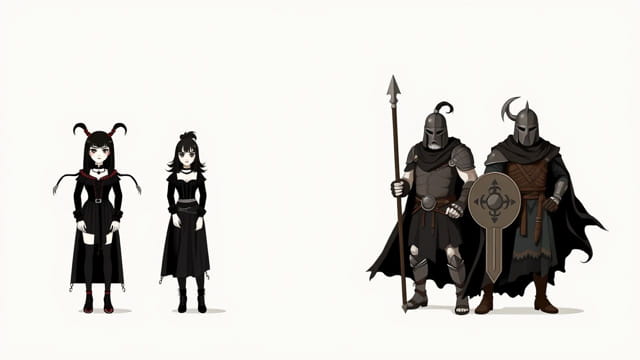
Mall Goths vs Visigoths
At first glance, comparing Mall Goths and Visigoths might seem like placing two entirely unrelated worlds side by side one rooted in ancient history, the other emerging from late 20th-century pop culture. Yet, both have carried a unique impact on their respective societies, representing rebellion, identity, and cultural shifts. Mall Goths are a subculture that took shape in modern consumerist settings, while Visigoths were a powerful Germanic tribe instrumental in the fall of the Western Roman Empire. Exploring the contrast between Mall Goths vs Visigoths opens an unexpectedly fascinating dialogue about how culture, aesthetics, and attitudes toward authority and mainstream society evolve over centuries.
Who Were the Visigoths?
Historical Background
The Visigoths were one of the two main branches of the Goths, an East Germanic people. Originating from Scandinavia and migrating through Eastern Europe, the Visigoths played a crucial role in shaping medieval European history. They are most famously known for sacking Rome in 410 AD under King Alaric I, an event that symbolized the decline of Roman power in the West.
Key Contributions and Legacy
- Established the Visigothic Kingdom in Hispania (modern-day Spain and Portugal).
- Developed a legal code known as the Visigothic Code, combining Roman law with tribal customs.
- Converted from Arian Christianity to Catholicism, influencing the religious fabric of Europe.
- Engaged in significant battles with the Franks, Moors, and Byzantines before eventually falling to Islamic conquest in the 8th century.
The Visigoths left behind an enduring cultural and political legacy that would later influence medieval kingdoms and Catholic Europe.
Who Are the Mall Goths?
The Rise of a Subculture
Mall Goths emerged in the late 1990s and early 2000s as a branch of goth culture. Unlike traditional goths who often gravitated toward underground music scenes and art, Mall Goths represented a more commercialized version. They were often found shopping at Hot Topic, listening to bands like Marilyn Manson or Evanescence, and wearing dramatic black clothing mixed with mass-produced accessories.
Visual and Cultural Aesthetic
- Heavy black eyeliner and pale makeup contrasted with colorful highlights or hair extensions.
- Chains, spiked collars, fishnet sleeves, and platform boots were common fashion elements.
- Music tastes ranged from nu-metal and industrial rock to darkwave and emo.
- Mall Goths embraced themes of alienation, identity, and anti-mainstream sentiment within a consumer-friendly environment.
Though often mocked for being ‘inauthentic,’ Mall Goths played a vital role in making goth culture more accessible to suburban teens and fostering creative expression in mainstream settings.
Comparing Mall Goths vs Visigoths
Cultural Context and Origins
The Visigoths originated as a tribal society with a military focus, driven by survival and power in a collapsing Roman world. Their actions had geopolitical consequences that reshaped the map of Europe. In contrast, Mall Goths arose from suburban angst and consumer culture, reflecting modern youth’s struggle for identity in an era of capitalism and media saturation.
- Visigoths: Born from migration and warfare during the late antiquity period.
- Mall Goths: Emerged from Western pop culture in shopping malls and music scenes.
Appearance and Aesthetic
Both groups adopted distinctive styles that set them apart from the mainstream of their time. Visigoths wore tribal attire suitable for warriors, while Mall Goths developed a dramatic and theatrical look influenced by media, fashion, and rebellion.
- Visigoths: Utilitarian dress, weapons, armor, and furs.
- Mall Goths: Dark clothing, theatrical makeup, band merchandise, and mass-market accessories.
Attitudes Toward Authority
The Visigoths directly challenged one of the most powerful empires in history the Roman Empire. Their rebellion was military, territorial, and political. On the other hand, Mall Goths symbolically rejected societal norms through fashion, music, and attitudes, opposing authority in a metaphorical sense.
- Visigoths: Destroyers of imperial structures.
- Mall Goths: Rebels within a capitalist system, often expressing nonconformity through appearance and music.
Role in Society
While Visigoths reshaped political boundaries and founded kingdoms, Mall Goths influenced youth culture, fashion trends, and the evolution of internet-based identity expression. Each group, in its own way, left a significant impact one through warfare and governance, the other through aesthetics and emotional subculture.
Why the Comparison Matters
Modern Interest and Symbolism
In recent years, the term ‘Goth’ has been used in both serious historical contexts and playful pop culture debates. Comparing Visigoths and Mall Goths may be humorous or ironic, but it also invites reflection on how different eras use identity, rebellion, and style to communicate deeper messages about society.
Cultural Echoes
Both Mall Goths and Visigoths share a sense of disconnection from dominant culture. The Visigoths rejected Roman domination; Mall Goths rejected corporate conformity, even as they shopped in malls. Their approaches differed swords versus eyeliner but the instinct to resist and redefine remained a shared thread.
Legacy and Perception
Historical vs. Cultural Impact
- Visigoths: Their legacy includes historical texts, ruined cities, and medieval legal codes.
- Mall Goths: Their influence can be seen in nostalgia-driven fashion trends, revived music appreciation, and the evolution of digital subcultures.
Though one group’s legacy is written in the annals of history and the other in social media threads and fashion revivals, both represent how human beings form groups, dress distinctively, and push against established norms to create meaning and identity.
The clash of Mall Goths vs Visigoths is less about conflict and more about contrast two expressions of culture separated by centuries but united by a shared desire to challenge the status quo. Whether through conquering empires or transforming shopping mall corridors into spaces of self-expression, both groups show that identity is always in motion, shaped by context, conflict, and creativity. Understanding these two forms of ‘Goth’ helps us appreciate how different generations respond to power, conformity, and the search for belonging.