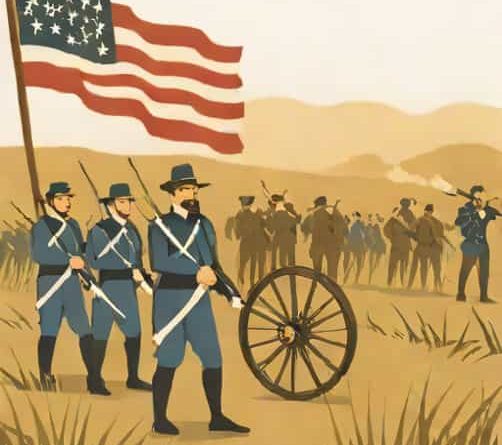
Battle Of Antietam Significance
The Battle of Antietam, fought on September 17, 1862, stands as one of the most significant and bloodiest days in American history. This clash between the Union and Confederate armies near Sharpsburg, Maryland, was not only a turning point in the American Civil War but also a defining moment for President Abraham Lincoln’s political and moral leadership. Understanding the significance of the Battle of Antietam involves exploring its military outcome, political consequences, and its lasting influence on American society and global perceptions of the United States during that era.
Background of the Battle
The Battle of Antietam was part of Confederate General Robert E. Lee’s first invasion of the North. Following his victory at the Second Battle of Bull Run, Lee moved his Army of Northern Virginia into Maryland, hoping to secure supplies, inspire Confederate sympathizers in the border states, and perhaps gain diplomatic recognition from European powers such as Britain and France. Union General George B. McClellan, commanding the Army of the Potomac, pursued Lee’s forces and intercepted them near Antietam Creek, setting the stage for one of the most intense confrontations of the Civil War.
The Battle’s Progression
The battle unfolded in three main phases morning, midday, and afternoon each marked by horrific casualties and brutal combat. The fighting began at dawn near the Cornfield, where Union and Confederate troops exchanged devastating fire. By midday, fierce clashes erupted around the Sunken Road, later called the Bloody Lane, where thousands of soldiers fell in just a few hours. In the afternoon, Union General Ambrose Burnside launched an assault on the Confederate right flank near a bridge that now bears his name Burnside Bridge. Despite the Union’s repeated attacks, Lee’s forces managed to hold their ground until reinforcements arrived from General A. P. Hill’s division, preventing a complete Confederate collapse.
Casualties and Immediate Outcome
The Battle of Antietam remains the single bloodiest day in American military history, with more than 22,000 soldiers killed, wounded, or missing. The scale of suffering shocked both the North and South. Although neither side achieved a decisive victory, Lee’s withdrawal back to Virginia the following day gave the Union a strategic advantage. General McClellan, however, failed to pursue the retreating Confederate army aggressively, which frustrated President Lincoln and ultimately led to McClellan’s removal from command.
Military Significance
From a purely military perspective, the Battle of Antietam halted Lee’s advance into Northern territory. It ended his campaign of 1862 and protected vital Union regions from invasion. The Union army demonstrated its ability to challenge the Confederates effectively, bolstering Northern morale after a series of earlier defeats. However, McClellan’s caution in not exploiting the Confederate retreat meant that the opportunity to destroy Lee’s army and potentially end the war sooner was lost.
Political Significance of the Battle of Antietam
The political significance of the Battle of Antietam cannot be overstated. For President Lincoln, it provided the necessary momentum to issue one of the most transformative documents in American history the Emancipation Proclamation. Before the battle, Lincoln had drafted the proclamation but waited for a Union military success to announce it publicly. A defeat could have made such a move appear desperate or weak. The Union’s performance at Antietam, though not a complete victory, offered a sufficient platform for Lincoln to act.
The Emancipation Proclamation
On September 22, 1862, just five days after the battle, Lincoln issued the preliminary Emancipation Proclamation. This document declared that as of January 1, 1863, all enslaved people in Confederate-controlled territories would be set free. The proclamation shifted the purpose of the Civil War from merely preserving the Union to also ending slavery. This change in moral focus strengthened the Union’s cause, undermined the Confederacy’s labor system, and discouraged European nations from recognizing or supporting the South.
- It redefined the Union war effort to include human freedom as a central goal.
- It prevented foreign powers, particularly Britain and France, from intervening on behalf of the Confederacy.
- It encouraged African Americans to enlist in the Union army, significantly boosting manpower.
Thus, the Battle of Antietam directly influenced the course of U.S. history by paving the way for the abolition of slavery and redefining national ideals of liberty and equality.
Social and Human Impact
Beyond politics and military strategy, the human cost of the Battle of Antietam deeply affected American society. The scenes of carnage and suffering were vividly captured by photographers like Alexander Gardner, whose images brought the realities of war into public view for the first time. Citizens in both the North and South were forced to confront the true horror of the conflict. Hospitals overflowed with wounded soldiers, and local civilians aided in caring for the injured, marking the beginnings of more organized wartime medical efforts.
The emotional toll also inspired growing movements for social reform. The bravery of soldiers on both sides and the sacrifices made by nurses and volunteers, including figures like Clara Barton who later founded the American Red Cross demonstrated the enduring human spirit amid tragedy.
Strategic and Global Implications
On a broader scale, the Battle of Antietam carried significant strategic and international implications. The Confederacy had hoped that a major victory on Northern soil would prompt Britain or France to recognize its independence. However, Lee’s retreat after Antietam dashed those hopes. European leaders, while sympathetic to the South’s cause, were hesitant to support a rebellion that now seemed unable to sustain its military momentum.
Moreover, Lincoln’s Emancipation Proclamation changed the diplomatic landscape. By linking the Union war effort to the abolition of slavery, Lincoln made it politically and morally impossible for European powers where slavery was already abolished to support the Confederacy without contradicting their own values. Thus, Antietam not only preserved the Union’s territorial integrity but also reshaped the global perception of the United States as a nation committed to freedom and equality.
Leadership Lessons from Antietam
The battle also revealed important lessons about leadership and command. General McClellan’s reluctance to act decisively has been a subject of debate among historians. Despite having superior numbers and intelligence he famously came into possession of Lee’s lost battle plans, known as Special Order 191 McClellan’s cautious nature prevented him from achieving a more conclusive victory. In contrast, Lee’s audacity and tactical brilliance allowed the Confederate army to survive despite being outnumbered.
For Lincoln, the aftermath of Antietam demonstrated the need for generals who were willing to take bold action. His decision to remove McClellan from command was a turning point in how the Union war effort was managed. It eventually led to the rise of more aggressive commanders like Ulysses S. Grant, whose determination helped bring the war to a close.
Long-Term Significance
The long-term significance of the Battle of Antietam extends far beyond its immediate aftermath. It stands as a symbol of sacrifice, endurance, and transformation in American history. The battle reaffirmed the Union’s resolve to continue fighting despite immense losses and marked the beginning of the end for the Confederacy. The moral reorientation of the war toward ending slavery laid the foundation for the eventual passage of the Thirteenth Amendment, which abolished slavery in the United States.
Legacy in Modern America
Today, the Antietam battlefield is preserved as a national historic site, serving as a solemn reminder of the cost of freedom and the price of unity. Each year, thousands visit the site to honor those who fought and to reflect on the broader meaning of the conflict. The lessons of Antietam continue to resonate in discussions about leadership, human rights, and the ongoing struggle to achieve equality and justice in society.
The Battle of Antietam was more than just a bloody clash between two armies it was a moment that reshaped the nation’s destiny. Its significance lies in its multifaceted impact: militarily, it halted the Confederate advance; politically, it empowered Lincoln to issue the Emancipation Proclamation; and morally, it redefined the purpose of the Civil War itself. Though marked by immense loss, Antietam remains a testament to the courage and conviction that ultimately preserved the Union and set the United States on a path toward freedom and equality for all. In the grand narrative of American history, the significance of the Battle of Antietam endures as a pivotal chapter in the struggle for both unity and human rights.