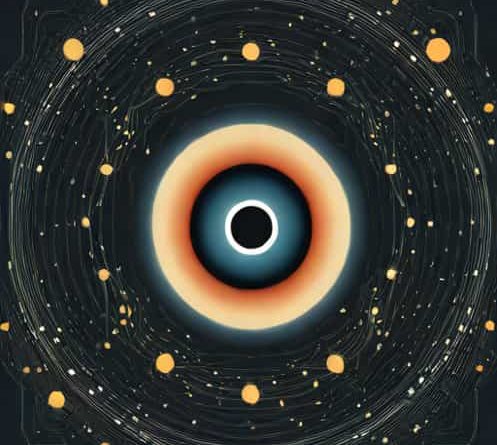
Eye Of The Universe Mandelbrot
The concept of the Eye of the Universe in connection with the Mandelbrot set offers a fascinating intersection between mathematics, cosmology, and philosophical exploration. The Mandelbrot set, a complex fractal discovered by Benoît Mandelbrot in the late 20th century, is renowned for its intricate patterns and self-similarity, which reflect the idea of infinite complexity emerging from simple rules. When enthusiasts and theorists speak of the Eye of the Universe, they often reference the Mandelbrot set’s central bulb or a symbolic point of convergence, where mathematical beauty and cosmic metaphors intersect. This concept invites both scientific curiosity and imaginative interpretation, bridging the gap between abstract mathematics and the awe-inspiring vastness of the universe.
The Mandelbrot Set Explained
The Mandelbrot set is a collection of complex numbers defined by the iterative formula zn+1= zn2+ c, where z starts at zero and c is a complex parameter. A point c belongs to the Mandelbrot set if the sequence does not diverge to infinity. The resulting visualization of this set reveals an endlessly intricate boundary, with shapes that repeat at smaller scales in an infinite, self-similar pattern known as a fractal. The set’s central region, sometimes referred to as the main cardioid, or the bulb of the Mandelbrot set, is where mathematicians and artists alike see the so-called Eye of the Universe.
Fractals and Infinite Complexity
One of the most striking features of the Mandelbrot set is its fractal nature. Fractals are patterns that exhibit self-similarity, meaning that zooming into any portion reveals structures resembling the whole. This characteristic allows mathematicians, physicists, and even cosmologists to draw metaphors between fractals and natural phenomena, from galaxy formations to branching patterns in biology. The Eye of the Universe metaphor captures the idea that at the heart of infinite complexity lies a point of focus or origin, symbolizing order within apparent chaos.
Symbolism of the Eye of the Universe
The phrase Eye of the Universe is both poetic and symbolic, representing a central point of observation, insight, or creation within the vast expanse of reality. In the context of the Mandelbrot set, this eye is visually associated with the central cardioid, the largest, smoothest area that anchors the surrounding chaotic boundary. Many see this as a metaphorical lens through which the universe itself can be contemplated-a single, unifying perspective within infinite complexity.
Metaphorical Interpretations
Philosophers, mathematicians, and artists often use the Eye of the Universe as a metaphor for understanding the cosmos. The Mandelbrot set, with its infinite zoom and ever-revealing structures, reflects ideas of infinity, emergence, and interconnectedness. The central eye represents the starting point or the origin of these patterns, suggesting a cosmic center from which complexity unfolds. Such interpretations resonate with both scientific and spiritual perspectives, making the Mandelbrot set a rich subject for contemplation beyond mathematics.
- Represents a central point in the infinite complexity of the Mandelbrot set.
- Symbolizes order emerging from chaos and the interconnectedness of systems.
- Serves as a metaphor for observation, insight, and the origin of patterns.
- Links mathematical structures to philosophical and cosmic ideas.
Mathematical Significance of the Central Bulb
The central bulb of the Mandelbrot set, often described as heart-shaped or cardioid, is mathematically significant. This area represents values of c for which the sequence exhibits stable, non-divergent behavior, creating a foundation for the fractal’s surrounding chaos. The stability of the central bulb contrasts with the highly intricate boundary, highlighting a recurring theme in mathematics and physics simple rules can generate complex outcomes. This balance between stability and chaos mirrors many natural systems, from orbital mechanics to fluid dynamics.
Exploring the Boundary
While the central bulb provides a visual and conceptual eye, the true beauty of the Mandelbrot set emerges at the boundary between stable and unstable regions. Here, the fractal complexity manifests in infinite spirals, tendrils, and miniature replicas of the whole set. Mathematicians study these boundary regions to understand chaos theory, bifurcations, and complex dynamical systems. Artists and visualizers, meanwhile, are drawn to the aesthetic appeal of these structures, often interpreting them as cosmic landscapes or universal designs.
Cosmic Analogies
The Mandelbrot set and the Eye of the Universe lend themselves naturally to cosmic analogies. Just as the central bulb anchors the fractal, many cosmological models seek a unifying principle or central focus in understanding the universe. The recursive, self-similar patterns of the Mandelbrot set echo structures observed in nature, from galaxy clusters to branching river systems. By using the Mandelbrot set as a metaphor, scientists and philosophers highlight the underlying order within seemingly random or chaotic processes.
Connections to Physics and Cosmology
Some researchers and theorists draw parallels between fractals and the large-scale structure of the universe. Galaxies, nebulae, and cosmic filaments display patterns reminiscent of fractal geometry. While the Mandelbrot set itself is a mathematical construct, it serves as a powerful illustration of how simple iterative rules can produce complexity on an immense scale. The Eye of the Universe, as the focal point of this fractal, can therefore be seen as a symbolic center in cosmic exploration, reflecting humanity’s quest to understand origins and structure.
- Highlights the balance of order and chaos in natural systems.
- Offers a visual metaphor for cosmic structures and patterns.
- Encourages philosophical reflection on the universe and infinity.
- Illustrates the universality of mathematical principles in nature.
Artistic and Visual Representations
Beyond mathematics, the Eye of the Universe has inspired countless artistic representations. Digital artists use high-resolution visualizations of the Mandelbrot set to create images that suggest cosmic landscapes, swirling galaxies, or mystical eyes watching over infinity. These representations often emphasize the central bulb, enhancing its symbolic role as the focal point of complexity. The interplay of color, scale, and repetition in these visualizations creates a compelling aesthetic experience that connects mathematical beauty with human imagination.
Interactive Exploration
Modern software allows enthusiasts to zoom endlessly into the Mandelbrot set, exploring deeper levels of complexity near the boundary and around the central eye. Each zoom reveals new structures and miniature copies of the entire set, emphasizing the fractal’s infinite nature. Interactive exploration not only provides visual pleasure but also deepens understanding of mathematical properties and fractal geometry. This hands-on experience encourages curiosity and engagement, making abstract concepts more tangible and inspiring new interpretations of the Eye of the Universe.
The Eye of the Universe as seen in the Mandelbrot set represents a unique intersection of mathematics, art, philosophy, and cosmology. The central bulb, or cardioid, serves as a symbolic focal point where stability meets infinite complexity, mirroring the balance between order and chaos found in natural and cosmic systems. Through fractal geometry, recursive patterns, and self-similarity, the Mandelbrot set provides insights into the beauty and intricacy of mathematical structures while inviting metaphorical exploration of the universe itself. By studying, visualizing, and contemplating the Eye of the Universe, mathematicians, artists, and thinkers alike can appreciate the endless wonder that arises from simple rules, highlighting the profound connections between mathematics and the cosmos.