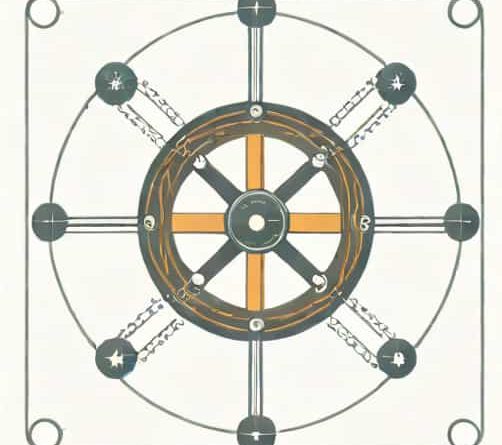
Fluxgate Magnetometer Working Principle
The fluxgate magnetometer is a highly sensitive instrument used to measure the strength and direction of magnetic fields. This device is widely employed in geophysics, space exploration, and navigation systems due to its accuracy and reliability. Understanding the working principle of a fluxgate magnetometer provides insight into how magnetic fields are detected and quantified using modern electronic technology. The instrument can measure extremely weak magnetic fields that are otherwise difficult to detect with conventional sensors, making it indispensable in applications ranging from mapping the Earth’s magnetic field to monitoring magnetic anomalies in engineering and research. Its combination of precision, sensitivity, and adaptability ensures that fluxgate magnetometers continue to play a central role in scientific and industrial applications.
Fundamentals of Magnetic Field Measurement
Magnetic fields are invisible forces generated by moving electric charges, magnetic materials, or planetary bodies. Measuring these fields accurately requires specialized sensors that can detect both the strength and orientation of the field. Fluxgate magnetometers are designed to sense the direction and magnitude of magnetic fields with high precision. They operate on principles of magnetic saturation and induction, converting magnetic signals into electrical outputs that can be analyzed electronically. This makes them more sensitive than many other types of magnetometers, such as Hall-effect sensors or inductive coils, especially for low-intensity fields.
Main Components of a Fluxgate Magnetometer
A fluxgate magnetometer typically consists of several key components that work together to detect magnetic fields
- Core MaterialUsually made from soft ferromagnetic material, the core is the element that becomes magnetically saturated in the presence of an external field.
- Drive CoilThis coil generates an alternating magnetic field that periodically saturates the core, enabling detection of the external magnetic field.
- Sense CoilWrapped around the core, the sense coil detects voltage changes induced by variations in the core’s magnetization, producing a measurable electrical signal.
- Electronic CircuitrySignal processing electronics amplify and convert the induced voltages into readable data, often compensating for noise and environmental factors.
Working Principle of a Fluxgate Magnetometer
The operation of a fluxgate magnetometer relies on the nonlinear properties of ferromagnetic materials, particularly their ability to become magnetically saturated. When an alternating current passes through the drive coil, it generates a time-varying magnetic field that saturates the core in alternating directions. In the absence of an external magnetic field, the core’s response is symmetrical, producing a predictable voltage in the sense coil. However, when an external magnetic field is present, it biases the core’s magnetization, causing an asymmetry in the induced voltage. This asymmetry can then be measured and translated into the strength and direction of the external magnetic field.
Step-by-Step Process
The fluxgate magnetometer operates in a sequence of steps that make magnetic field measurement possible
- ExcitationThe drive coil is energized with an alternating current, creating a magnetic field that saturates the ferromagnetic core in both polarities.
- Core ResponseThe core’s magnetization changes in response to both the applied field and any external magnetic field.
- Induced VoltageThe sense coil detects changes in the core’s magnetization, generating an electrical signal proportional to the external magnetic field.
- Signal ProcessingElectronics extract the component of the induced voltage that is proportional to the external field, filtering out the background signal caused by the drive coil.
- OutputThe processed signal is converted into readable data, typically in units of microteslas or nanoteslas, indicating the strength and orientation of the magnetic field.
Types of Fluxgate Magnetometers
Fluxgate magnetometers come in several designs, each tailored for specific applications
- Single-Axis FluxgateMeasures the magnetic field along one direction and is commonly used in portable instruments.
- Three-Axis FluxgateMeasures magnetic fields along three perpendicular axes simultaneously, providing a complete vector representation of the field.
- Ring-Core FluxgateFeatures a toroidal core that enhances sensitivity and reduces the effects of environmental interference.
- Planar FluxgateUtilizes a flat core geometry suitable for miniaturized applications in satellites and compact devices.
Applications of Fluxgate Magnetometers
The versatility of fluxgate magnetometers allows them to be used across diverse fields
- Geophysical SurveysMapping the Earth’s magnetic field to detect mineral deposits, underground structures, and tectonic activity.
- Space ExplorationMeasuring planetary magnetic fields and monitoring space weather for satellite and spacecraft missions.
- NavigationAssisting in compass-based navigation for submarines, ships, and aircraft in environments where GPS may not be reliable.
- ResearchStudying magnetic anomalies, laboratory experiments in physics, and monitoring environmental magnetic changes.
Advantages of Fluxgate Magnetometers
Fluxgate magnetometers offer several benefits over other types of magnetic sensors
- High SensitivityCapable of detecting very weak magnetic fields, even at nanotesla levels.
- Directional AccuracyProvides precise measurements of both magnitude and direction of the magnetic field.
- Low NoiseAdvanced designs reduce interference, allowing accurate readings in various environments.
- ReliabilityDurable and consistent performance over long periods, suitable for field and laboratory use.
Limitations and Considerations
Despite their advantages, fluxgate magnetometers have certain limitations. They may require careful calibration to maintain accuracy, especially in environments with fluctuating temperatures or strong electromagnetic interference. Additionally, the device’s sensitivity can make it susceptible to local magnetic anomalies or nearby ferromagnetic objects, requiring careful placement and shielding. Users should also consider the power requirements and physical size of the sensor, particularly for portable or space-constrained applications.
The fluxgate magnetometer remains one of the most reliable and precise instruments for measuring magnetic fields, combining advanced electronic signal processing with the fundamental properties of ferromagnetic materials. By understanding the working principle, which involves core saturation, induced voltage detection, and signal processing, users can appreciate the instrument’s capability to measure both the strength and direction of magnetic fields accurately. With applications ranging from geophysical surveys to space missions, navigation, and scientific research, the fluxgate magnetometer continues to be an essential tool for professionals and researchers who require precise and dependable magnetic field measurements. Its unique combination of sensitivity, directional accuracy, and versatility ensures that it will remain a cornerstone of magnetic measurement technology for years to come.