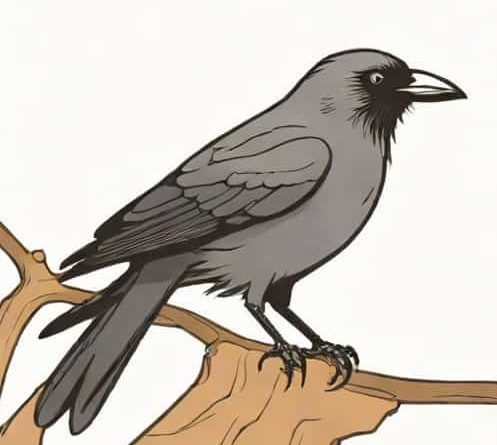
Is A Jackdaw A Crow
When people see a small black bird with glossy feathers and a curious nature, they often wonder is a jackdaw a crow? This question arises because jackdaws share many similarities with crows, ravens, and rooks. All these birds belong to the same family, Corvidae, which is known for its intelligence, adaptability, and striking black plumage. However, while the jackdaw is closely related to crows, it is not exactly the same species. Understanding the relationship between jackdaws and crows reveals fascinating insights into bird classification, behavior, and evolution.
Understanding the Corvid Family
Both jackdaws and crows belong to the Corvidae family, which also includes magpies, rooks, jays, and ravens. Members of this family are often referred to as corvids. They are among the most intelligent birds in the world, capable of problem-solving, using tools, and even recognizing human faces. The main difference between the various corvids lies in their size, calls, plumage, and social behaviors.
In scientific classification, the jackdaw is known as Corvus monedula, while the common crow is usually Corvus corone (the carrion crow) or Corvus brachyrhynchos (the American crow). Both share the genus Corvus, meaning they are closely related. However, their differences are significant enough for ornithologists to classify them as separate species within the same genus.
Physical Differences Between Jackdaws and Crows
While jackdaws and crows share the same black coloration, a closer look reveals several distinct features that set them apart. These differences can be seen in their size, feathers, eyes, and overall appearance.
Size and Build
Jackdaws are noticeably smaller than crows. On average, a jackdaw measures about 34-39 cm (13-15 inches) in length, while a crow can grow up to 45-50 cm (17-20 inches). The jackdaw also has a more compact body and shorter wingspan, giving it a quicker, more agile flight. In contrast, crows have broader wings and a heavier build, allowing for steadier gliding.
Feathers and Coloration
Although both birds appear black from a distance, the jackdaw’s plumage has a silvery or grey sheen around the back of its head and neck. This gives it a slightly two-toned look, especially when sunlight reflects on its feathers. Crows, on the other hand, are uniformly black from head to tail, including their beak and legs, and may display a faint blue or purple gloss under bright light.
Eyes and Expression
One of the most striking features of a jackdaw is its pale, almost white or silvery eyes, which give it a bright and curious appearance. Crows have dark brown or black eyes, making their expression seem more intense or mysterious. This difference in eye color is often the easiest way to distinguish between the two species at a glance.
Behavioral and Social Differences
In addition to their physical traits, jackdaws and crows also differ in how they behave, communicate, and interact with one another. Observing their behavior provides valuable insight into their distinct personalities and lifestyles.
Communication and Calls
Jackdaws have a lighter, more metallic chak or jack sound, which is where their name comes from. Their calls are often shorter and higher-pitched compared to the deeper, cawing sound of crows. When a group of jackdaws communicates, their chatter can sound lively and almost conversational, while crows’ calls tend to be slower and more deliberate.
Social Behavior
Jackdaws are highly social birds that often live in tight-knit groups. They mate for life and maintain strong pair bonds, frequently seen flying, nesting, or feeding together. Jackdaws also form large colonies and roost in communal areas, showing complex social organization. Crows are also social but tend to live in smaller family groups or loose communities. They are known for their intelligence and adaptability, often cooperating to solve problems or find food.
Habitat and Distribution
Jackdaws are found throughout Europe, western Asia, and parts of North Africa. They prefer open countryside, farmland, and urban areas where tall buildings or cliffs provide nesting sites. Crows, on the other hand, have a much broader range, appearing almost worldwide in various environments, from forests and fields to city parks and coastlines. Their adaptability is one reason they are among the most widespread birds on the planet.
Diet and Feeding Habits
Both jackdaws and crows are omnivorous, meaning they eat a wide variety of foods. However, their feeding behavior differs slightly due to their size and environment.
- JackdawsThey primarily feed on insects, seeds, grains, and scraps of human food. They are skilled at foraging in open fields or near human settlements, often scavenging in towns or farms.
- CrowsCrows eat a broader range of foods, including carrion, small mammals, eggs, fruits, and even other birds. They are opportunistic feeders, using their intelligence to exploit available resources, such as opening trash bins or using tools to access food.
Both species play a vital role in their ecosystems by cleaning up waste and controlling insect populations, making them valuable members of their natural habitats.
Intelligence and Problem-Solving
Jackdaws and crows are both remarkably intelligent birds. They are known for their problem-solving skills, ability to use tools, and social learning. In some experiments, jackdaws have demonstrated an understanding of human gestures and can recognize individual human faces. Crows, similarly, are capable of planning ahead, using logic, and even holding grudges against people who threaten them.
What distinguishes the jackdaw’s intelligence is its social awareness. Studies show that jackdaws can interpret eye direction, meaning they can tell when a person or another bird is looking at them-a rare ability in animals. This helps them navigate complex social interactions within their colonies.
Mythology and Cultural Symbolism
Both jackdaws and crows have rich symbolic meanings in folklore and mythology. In many cultures, crows are seen as symbols of intelligence, mystery, and transformation. They often appear in myths as messengers or omens. Jackdaws, on the other hand, are sometimes associated with curiosity and cleverness. In British folklore, jackdaws were thought to bring good luck if they nested in a house’s roof. Their playful nature has also made them a symbol of mischief and adaptability.
Are Jackdaws and Crows the Same?
So, is a jackdaw a crow? The answer is both yes and no. A jackdaw is part of the crow family and shares many characteristics with crows, such as intelligence, black plumage, and omnivorous habits. However, it is a distinct species with unique traits, including smaller size, lighter eyes, and a different call. In simple terms, all jackdaws are crows in a broad sense (since they belong to the genus Corvus), but not all crows are jackdaws.
How to Tell Them Apart in the Wild
When observing birds in the wild, it can be challenging to distinguish a jackdaw from a crow, especially at a distance. Here are a few tips that can help identify them correctly
- Look for the silvery grey neck and lighter eyes-that’s a jackdaw.
- If the bird is large, entirely black, and has a deep caw, it’s likely a crow.
- Jackdaws often move in pairs or small groups, while crows may appear alone or in smaller family units.
- Jackdaws prefer rooftops, towers, or chimneys for nesting; crows build larger nests in tall trees.
The question is a jackdaw a crow opens the door to understanding one of the most fascinating families in the bird world-the Corvidae. While jackdaws and crows share close genetic ties and similar behaviors, they are distinct in size, sound, and social habits. The jackdaw’s lively personality, pale eyes, and communal lifestyle make it stand out, while the crow’s intelligence and versatility allow it to thrive almost anywhere. Together, they represent nature’s perfect blend of curiosity and cleverness, reminding us that even among similar creatures, subtle differences make each species unique and remarkable.