What Type Of Star Is Fomalhaut
Fomalhaut is one of the brightest stars in the night sky and has long fascinated astronomers and stargazers alike. Located in the constellation Piscis Austrinus, this star is notable not only for its brilliance but also for its unique characteristics and surrounding planetary system. Understanding what type of star Fomalhaut is, along with its physical properties and cosmic significance, helps provide a clearer picture of our galaxy and the diversity of stellar objects within it. As an important subject of study in astrophysics, Fomalhaut continues to reveal insights into star formation, planetary systems, and stellar evolution.
Overview of Fomalhaut
Fomalhaut, also designated as Alpha Piscis Austrini, is a bright, relatively nearby star located approximately 25 light-years from Earth. Its apparent magnitude of around 1.16 makes it one of the 20 brightest stars visible from Earth, easily observable in the southern hemisphere. The star has been studied extensively due to its brightness, youth, and the presence of a circumstellar debris disk, which indicates the potential formation of planets and other celestial bodies.
Fomalhaut has been an object of fascination throughout history, with ancient civilizations recognizing its significance in navigation and astronomy. Its visibility and prominent location in the southern sky have made it a key reference point for astronomers and stargazers.
Type of Star
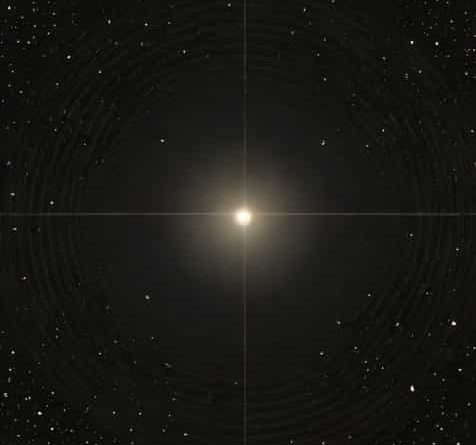
Fomalhaut is classified as an A-type main-sequence star, often denoted as spectral type A3V. A-type stars are characterized by their white or bluish-white color, relatively high surface temperatures, and strong hydrogen absorption lines in their spectra. Being on the main sequence indicates that Fomalhaut is currently fusing hydrogen into helium in its core, which is the primary phase of a star’s life cycle.
Characteristics of A-Type Main-Sequence Stars
A-type stars, including Fomalhaut, exhibit several distinct features
- Surface TemperatureFomalhaut has a surface temperature of approximately 8,590 Kelvin, giving it a bright white hue.
- MassIt is about 1.92 times the mass of the Sun, making it more massive and luminous than our solar system’s star.
- LuminosityFomalhaut is around 16.6 times more luminous than the Sun, which contributes to its prominence in the night sky.
- Main-Sequence StatusAs a main-sequence star, Fomalhaut is in a stable phase of its life, with hydrogen fusion occurring in its core.
These characteristics make A-type stars like Fomalhaut shorter-lived than less massive stars, such as our Sun, with main-sequence lifespans typically ranging from a few hundred million to around two billion years.
Physical Properties of Fomalhaut
In addition to its classification, Fomalhaut exhibits several physical properties that make it a subject of interest in astrophysics. Its radius is approximately 1.84 times that of the Sun, and its mass allows it to exert significant gravitational influence on surrounding material, including its debris disk. Fomalhaut also rotates relatively rapidly, with an equatorial rotational velocity of about 93 km/s, which is considerably faster than the Sun’s rotation.
The star is relatively young, estimated to be around 440 million years old. This youthfulness contributes to the presence of a well-defined circumstellar disk, a feature often observed around younger stars where planet formation is still ongoing or has recently occurred.
Fomalhaut’s Debris Disk and Planetary System
One of the most intriguing aspects of Fomalhaut is its circumstellar debris disk, discovered through infrared observations. The disk consists of dust, ice, and other material, suggesting active processes of planet formation. Observations have also indicated the presence of at least one confirmed exoplanet, Fomalhaut b, which orbits within the disk. This discovery has made Fomalhaut a key example of a young star system with active planet-forming regions, offering insights into the early stages of planetary system evolution.
The debris disk around Fomalhaut provides astronomers with opportunities to study disk morphology, dust composition, and potential gravitational interactions with planets. The star’s brightness and proximity to Earth make these observations feasible with current telescopic technology.
Significance in Astronomy
Fomalhaut holds significant importance in multiple areas of astronomy and astrophysics. As a nearby and bright A-type star with a young age, it serves as a reference for studying stellar evolution, main-sequence lifetimes, and star-planet interactions. Its debris disk and planetary system provide a natural laboratory for understanding planet formation, orbital dynamics, and disk-planet interactions. By studying Fomalhaut, astronomers gain valuable knowledge applicable to other star systems and the broader processes governing the universe.
Historical and Cultural Importance
Throughout history, Fomalhaut has been recognized by various cultures for its brightness and location in the southern sky. Its name originates from the Arabic phraseFum al Hut, meaning mouth of the fish, referencing its position in the constellation Piscis Austrinus. Ancient navigators and astronomers used Fomalhaut as a guide, and it has maintained cultural relevance in literature and celestial mythology.
Observing Fomalhaut
For stargazers and amateur astronomers, Fomalhaut is relatively easy to observe due to its brightness and distinct location. In the southern hemisphere, it is most visible during the late spring and summer months. The star can be seen with the naked eye, appearing as a bright white point of light. Using binoculars or a small telescope can reveal additional features of the surrounding region, including the presence of nearby stars and, under advanced imaging, its debris disk.
- VisibilityBest observed in the southern sky, particularly in the constellation Piscis Austrinus.
- BrightnessApparent magnitude of 1.16, making it one of the brightest stars in the night sky.
- ColorWhite to bluish-white, characteristic of A-type stars.
Scientific Observations
Modern astronomical tools, including space telescopes and advanced ground-based observatories, have allowed scientists to study Fomalhaut’s disk, planetary system, and stellar properties in detail. Observations in infrared, visible, and ultraviolet light provide insights into its temperature, chemical composition, and interactions with orbiting bodies. These studies contribute to broader research on star and planet formation, helping astronomers model the evolution of other stellar systems.
Fomalhaut is an A-type main-sequence star with unique characteristics that make it a focal point of astronomical research and cultural interest. Its brightness, relative proximity to Earth, and young age provide an ideal setting for studying star formation, stellar evolution, and planetary system development. The presence of a circumstellar debris disk and at least one confirmed exoplanet highlights its importance in understanding how planets form and evolve around young stars. Observations of Fomalhaut continue to expand our knowledge of the universe, making it not only a prominent feature of the night sky but also a cornerstone of modern astrophysics. By studying Fomalhaut, astronomers gain valuable insights into stellar dynamics, exoplanetary systems, and the processes that shape our cosmic neighborhood.