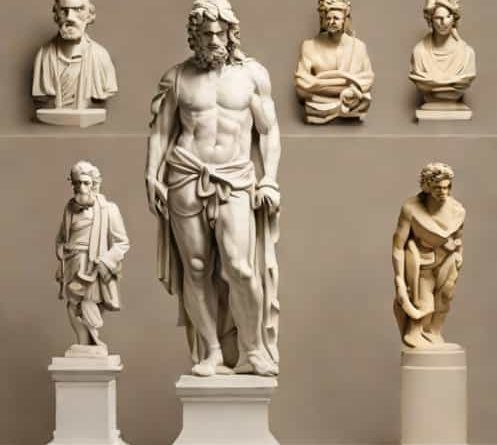
Gian Lorenzo Bernini Sculptures
Gian Lorenzo Bernini is widely regarded as one of the most influential sculptors and architects of the Baroque period, whose works have left an indelible mark on the artistic and cultural landscape of Rome and beyond. His sculptures are renowned for their dramatic expression, intricate detail, and ability to convey intense emotion, often blurring the line between marble and life itself. Over the course of his career, Bernini produced a remarkable range of works, from religious masterpieces to secular commissions, each demonstrating his technical brilliance and imaginative vision. His ability to capture movement, personality, and spiritual intensity in stone transformed sculpture into a dynamic storytelling medium, inspiring generations of artists who followed. Exploring Bernini’s sculptures offers insight into the Baroque era’s fascination with drama, theatricality, and human emotion, all of which are encapsulated in his extraordinary creations.
Early Life and Artistic Training
Gian Lorenzo Bernini was born in Naples, Italy, in 1598, into a family with a strong artistic background. His father, Pietro Bernini, was a successful sculptor who provided young Gian Lorenzo with early training in the fundamentals of sculpting and design. From a young age, Bernini displayed exceptional talent, mastering techniques that would later define his distinctive style. By his teenage years, he was already receiving commissions for religious sculptures and had begun to attract attention from influential patrons. His early works reveal a combination of technical skill and emotional sensitivity that would become hallmarks of his mature style.
Influences and Artistic Development
Bernini’s artistic development was influenced by classical sculpture, Renaissance masters like Michelangelo, and the vibrant religious atmosphere of Counter-Reformation Rome. He studied the works of ancient Roman sculptures and Renaissance techniques, combining these with his own innovative approach to create dynamic compositions full of movement and theatricality. His understanding of anatomy, perspective, and human emotion allowed him to craft figures that appeared alive, almost as if frozen in motion. This synthesis of classical inspiration and Baroque innovation set the stage for his later masterpieces.
Major Sculptural Works
Bernini’s sculptural oeuvre spans a variety of themes, including religious, mythological, and portrait works. His ability to convey complex narratives through marble made him a sought-after artist for churches, palaces, and public spaces. Each sculpture demonstrates his meticulous attention to detail, mastery of drapery and texture, and ability to imbue stone with emotional depth. Below are some of his most celebrated sculptures.
The Ecstasy of Saint Teresa
One of Bernini’s most iconic works,The Ecstasy of Saint Teresa, is located in the Cornaro Chapel of Santa Maria della Vittoria in Rome. Completed in 1652, this sculpture captures the mystical experience of Saint Teresa of Ávila as she is pierced by an angel’s arrow, an event she described as a spiritual rapture. Bernini’s genius is evident in the fluidity of the marble, the expressive faces, and the dramatic folds of fabric that enhance the sense of movement. The play of light, architecture, and sculpture together creates an immersive experience that is quintessentially Baroque.
Apollo and Daphne
Another masterpiece,Apollo and Daphne, completed in 1625, depicts the moment of transformation from Ovid’s Metamorphoses, where Daphne escapes Apollo by turning into a laurel tree. The sculpture is celebrated for its intricate detail and dynamic composition. Bernini’s skill in rendering textures skin, hair, and leaves in marble brings the mythological narrative vividly to life. The sense of motion is palpable, with Apollo reaching forward and Daphne’s fingers transforming into branches, demonstrating Bernini’s ability to capture an instant frozen in time.
David
Bernini’sDavid, created in 1623 1624, diverges from earlier representations of the biblical hero by depicting him in the midst of action, preparing to launch the stone at Goliath. Unlike static Renaissance depictions, Bernini’s David is captured in motion, muscles tense, and expression focused. This sculpture exemplifies the Baroque emphasis on dynamism, drama, and psychological intensity, highlighting Bernini’s innovative approach to traditional subjects.
Fountain of the Four Rivers
In addition to free-standing sculptures, Bernini’s skill extended to monumental public works such as theFountain of the Four Riversin Piazza Navona, completed in 1651. The fountain features four river gods representing major rivers of the known continents the Nile, the Ganges, the Danube, and the Rio de la Plata. Each figure is carefully modeled with attention to anatomy, movement, and expression, interacting with the naturalistic elements of water and rock. The fountain reflects Bernini’s ability to integrate sculpture with urban space, creating a dramatic and theatrical environment.
Techniques and Innovations
Bernini revolutionized sculpture through his technical mastery and innovative approaches. He was particularly known for his ability to convey motion, emotion, and narrative depth through marble. His works often feature
- Highly detailed textures that mimic real-life materials, such as fabric, hair, and skin.
- Complex compositions with spiraling, dynamic forms that create a sense of movement.
- Use of theatrical elements, including strategic lighting and architectural framing, to enhance dramatic impact.
- Integration of sculpture with surrounding spaces to create immersive experiences.
- Expression of psychological states and emotional intensity through facial expressions and body language.
Impact and Legacy
Gian Lorenzo Bernini’s sculptures left a lasting impact on the art world, influencing countless artists and shaping the Baroque aesthetic. His ability to combine technical virtuosity with emotional resonance set a new standard for sculpture. Artists across Europe studied his techniques, and his works continue to attract scholars, art lovers, and tourists alike. Bernini’s legacy extends beyond his sculptures, as his architectural projects, fountains, and urban designs also reflect the same theatricality and expressive power seen in his carvings. By bridging classical ideals with Baroque dynamism, Bernini created art that remains timeless and inspiring.
Influence on Later Artists
- Bernini’s dynamic approach influenced Baroque and Rococo sculptors across Italy and Europe.
- Artists adopted his methods of integrating sculpture with architecture and urban space.
- His emphasis on emotional realism and narrative inspired generations of portrait and religious sculptors.
- Modern sculptors study Bernini’s works for lessons in movement, expression, and composition.
- His sculptures continue to be central to art historical studies and museum collections worldwide.
Gian Lorenzo Bernini’s sculptures are extraordinary testaments to human creativity, skill, and imagination. Through works likeThe Ecstasy of Saint Teresa,Apollo and Daphne, andDavid, Bernini demonstrated an unparalleled ability to capture motion, emotion, and narrative depth in marble. His technical innovations, combined with his visionary approach to storytelling and dramatic composition, transformed sculpture in the Baroque era and left a legacy that continues to inspire artists and admirers today. By studying Bernini’s works, we gain a deeper appreciation for the artistry, complexity, and cultural significance of Baroque sculpture, as well as the enduring genius of one of history’s greatest sculptors.